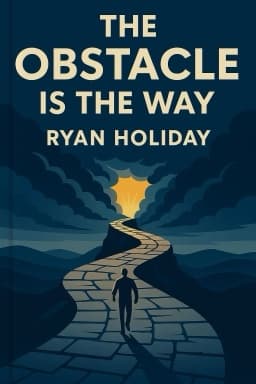
Ryan Holiday
A practical guide inspired by Stoicism to transform obstacles into opportunities through perception, action, and will.
Ryan Holiday credits Dr. Drew Pinsky for introducing him to Stoicism.
Section 1
10 Sections
Imagine standing before a great mountain. To many, it is an imposing obstacle, an immovable barrier. But what if this mountain is not a wall but a path?
Take the story of a Roman emperor, who amid the chaos of war and plague, penned a simple yet revolutionary idea: that impediments to action actually advance action. What stands in the way becomes the way. This is not mere optimism; it is a disciplined approach to reality. His reign was marked by relentless challenges, yet he met each with calm and resolve, embodying virtues that turned hardship into strength.
Fast forward to a young man in 1857, amidst a national financial panic. While others fled in fear, he observed with a steady gaze, refusing to be swept away by panic. This man would later control 90% of the oil market. His secret was not luck but the ability to see opportunity where others saw disaster.
Perception is our first and most powerful tool. It determines whether we feel powerless or empowered, whether we see a problem or a puzzle. We are never completely at the mercy of external events because we control our interpretation of them. Even when imprisoned unjustly, some have found freedom in their minds, choosing not to surrender their inner selves.
But perception is not passive. It requires discipline to steady nerves, control emotions, and practice objectivity. When fear threatens to overwhelm, we can remind ourselves that panic clouds judgment and that calmness is a strategic advantage. Like a skilled warrior, we learn to see only what is, not what we fear or imagine.
Changing perspective can shrink mountains. What once seemed terrifying can become manageable when viewed from a different angle. History is full of examples where reframing a challenge led to breakthrough: a general holding his nerve under fire, a pioneer embracing harsh lands as adventure, a young actor shifting from self-pity to seeing himself as the solution to a casting director’s problem.
And crucially, we must distinguish what is within our control from what is not. Our emotions, judgments, and actions are ours to command; the weather, the economy, and others’ opinions are not. Focusing on what we can change magnifies our power and conserves energy.
Living in the present moment grounds us further. Many great companies were born during economic downturns because their founders focused not on the storm but on the work at hand. Overthinking and worrying about what might happen drains energy and clouds clarity. Instead, by focusing on the immediate, we find the strength to move forward, moment by moment.
Finally, thinking differently expands what is possible. Visionaries refuse to accept limits imposed by others or by convention. They push boundaries, inspiring innovation and progress. This mindset is not naive but bold and pragmatic, rooted in faith in one’s ability to create and adapt.
What is the core idea behind changing perception when facing obstacles?
19 more quizzes available in app
How we interpret events influences our emotional and practical responses.
8 more insights available in app
Unlock all 10 sections, 9 insights, full audio, and interactive mind map in the SnapBooks app.
Discover the ancient wisdom that transforms every challenge into an opportunity for success and growth.
Read articleExplore the practical Stoic strategies that turn life’s chaos into your greatest ally.
Read article
Ali Abdaal
Dick Schaefer; Pamela Espeland
Robin Sharma
Jeff Haden
