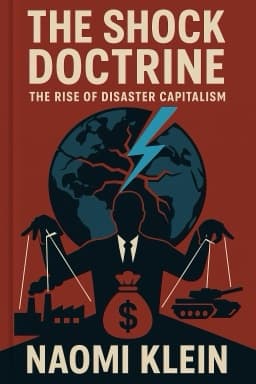
Naomi Klein
An incisive critique of how crises are exploited to impose radical free-market policies, revealing the human cost of disaster capitalism.
Naomi Klein's research for the book took over four years and included extensive travel to places like Iraq, Sri Lanka, and Latin America.
Section 1
7 Sections
Imagine a world where the mind itself becomes a battlefield. In the early 1950s, covert experiments sought to unravel the very fabric of human identity through relentless electroshock therapy and sensory deprivation.
Parallel to this dark exploration of the human psyche was a revolutionary economic theory. It proposed that societies, much like minds, could be reset through sudden, painful shocks.
These two seemingly disparate domains—psychology and economics—shared a haunting logic: destruction as a prelude to creation. The mind’s trauma mirrored the economy’s upheaval. The lessons from mind control experiments would later inform interrogation methods, while economic shock therapy would become the blueprint for transforming entire nations under duress.
Consider the metaphor of a storm clearing a forest to make way for new growth. But instead of gentle renewal, the shock doctrine employs a tempest of violence and upheaval, leaving devastation in its wake.
As we journey deeper, we will see how these theories moved from laboratories and lecture halls into the streets and governments of nations, wielded by those who saw opportunity in chaos. But before we step forward, remember: the roots of disaster capitalism are entwined with the darkest experiments on the human mind, a sobering beginning to a story of power, pain, and resistance.
Let us now turn to how these ideas were brutally tested and implemented in the crucible of authoritarian regimes.
What was the primary goal of the CIA-funded electroshock experiments in the 1950s?
13 more quizzes available in app
Using trauma to break down individuals’ mental resistance.
8 more insights available in app
Unlock all 7 sections, 9 insights, full audio, and interactive mind map in the SnapBooks app.
Unveiling the hidden forces that turn human suffering into corporate gain and political control.
Read articleTracing the chilling evolution from psychological experiments to global economic policies.
Read article
Yanis Varoufakis
Erik Olin Wright
Joseph A. Schumpeter
Bryan Caplan
