Fritjof Capra
A groundbreaking exploration of how modern physics and Eastern mysticism converge on a unified, dynamic, and holistic worldview.
The Tao of Physics was first published in 1975 and has sold over a million copies worldwide.
Section 1
9 Sections
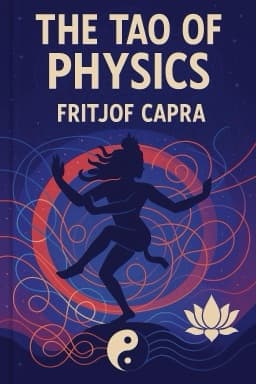
Imagine sitting on a peaceful beach, the rhythmic sound of waves blending with the steady cadence of your breath. Suddenly, the veil of ordinary perception lifts, and you sense the entire universe engaged in a magnificent cosmic dance. This is no mere poetic fancy, but a profound insight into the very fabric of reality. The sand beneath your feet, the air around you, the atoms within your body—all are participants in a rhythmic interplay of creation and destruction, energy and matter. This dance, known in ancient Indian tradition as the Dance of Shiva, reveals a universe far more dynamic and interconnected than classical science had ever imagined.
For centuries, Western science viewed the universe as a mechanical system, a grand clockwork governed by immutable laws. This mechanistic worldview, rooted in Cartesian dualism, separated mind from matter, observer from observed, and fractured the unity of existence into isolated parts. While this perspective enabled remarkable technological progress, it also fostered a cultural imbalance—favoring masculine, analytical, and competitive values at the expense of feminine, intuitive, and cooperative ones.
Yet, as the twentieth century dawned, physics began to reveal a different story. The discoveries of quantum mechanics and relativity shattered the classical edifice, unveiling a universe where particles are not isolated entities but interwoven patterns of energy, where space and time merge into a dynamic continuum, and where the observer participates in shaping reality. These revelations resonate deeply with the ancient philosophies of the East, where the universe is seen as an organic whole, alive and pulsating with the dance of opposites.
Eastern mysticism—embodied in the teachings of Hinduism, Buddhism, Taoism, and Zen—has long emphasized the unity of all things, the fluidity of forms, and the transcendence of dualities. Unlike Western mysticism, often marginalized, these traditions form the core of their cultures' spiritual life, offering rich philosophical frameworks that harmonize remarkably with the insights of modern physics.
As we embark on this exploration, consider the cultural significance of restoring balance—between rationality and intuition, analysis and synthesis, self-assertion and integration. The path illuminated by modern physics, enriched by Eastern wisdom, invites us to embrace a holistic worldview that honors the interconnectedness of all life. It is a path with a heart, one that holds promise for healing both ourselves and the world we inhabit.
Let us now delve deeper into the nature of knowledge itself, to understand how science and mysticism approach the mysteries of existence through different yet complementary modes of knowing.
What metaphor was used to describe the physicist's experience linking atomic physics to Eastern mysticism?
17 more quizzes available in app
Modern physics not only advances science but also opens pathways aligned with spiritual insight and holistic understanding.
8 more insights available in app
Unlock all 9 sections, 9 insights, full audio, and interactive mind map in the SnapBooks app.
Discover the surprising parallels between the cutting-edge science of the quantum world and ancient Eastern wisdom that may transform your worldview.
Read articleWhy the latest physics discoveries are shaking up not just science but also spirituality—and what that means for your understanding of reality.