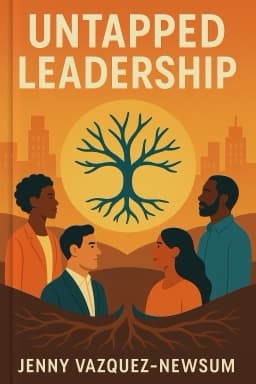
Jenny Vazquez-Newsum
A transformative exploration of leadership through the lens of marginalized leaders, advocating for inclusive, authentic, and purpose-driven leadership to reshape organizations and society.
More than 90% of leadership books are authored by white men, reflecting the dominance of traditional leadership perspectives.
2 more facts available in the app
Section 1
9 Sections
Leadership, as we know it today, did not emerge in a vacuum. Its foundations are deeply intertwined with historical narratives that favored a very narrow group of people—primarily white, cisgender, heterosexual men. Imagine a towering tree, its roots sunk deep into the soil of 19th-century thought, nourished by ideas that equated leadership with heredity and divine favor. This tree’s branches stretch wide, but its growth is constrained by the soil it draws from.
The Great Man Theory gave us the archetype of the heroic leader, a figure who was born to lead, possessing innate qualities that set them apart. This idea was not just about qualities but about who was deemed worthy of leadership—often excluding entire groups based on race, gender, and class. These early theories were influenced by eugenics, a discredited belief that certain traits, including leadership, were inherited and tied to racial superiority. Such thinking cemented a leadership ideal that was exclusionary by design.
As time progressed, behavioral and situational leadership theories emerged, offering more nuance. Yet, even these frameworks often failed to escape the shadows of their origins. Personality assessments like the Myers-Briggs Type Indicator, widely used in workplaces to categorize leadership styles, carry subtle biases rooted in their creators’ cultural contexts. These tools, while helpful in some respects, have also contributed to sorting and categorizing people in ways that limit diverse expressions of leadership.
Today, we see the fruit of this legacy in organizations where leadership remains disproportionately white and male. Despite decades of diversity initiatives, the fundamental definitions of leadership have changed little, continuing to favor those who fit the traditional mold.
Reflect on how this history affects us all. When leadership is defined by a select few, it shapes organizational cultures, hiring practices, and promotion criteria that often leave marginalized voices unheard and unseen. The challenge before us is to recognize these deeply embedded roots and begin the work of unlearning and expanding our understanding of what leadership can be.
As we move forward, we will explore how these limitations manifest in today's leadership culture and the unique capacities that underrepresented leaders bring to the table. Let us now turn to the present state of leadership and the urgent need for change.
Which early theory linked leadership ability to heredity?
17 more quizzes available in app
Leadership theories originated with exclusionary, biased perspectives that still influence modern leadership culture.
8 more insights available in app
Unlock all 9 sections, 9 insights, full audio, and interactive mind map in the SnapBooks app.
Discover the deep roots of leadership theories and how outdated models continue to exclude diverse voices.
Read articleExploring the persistence of toxic leaders and practical ways to build healthier leadership environments.
Read article