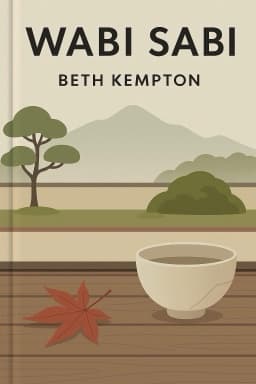
Beth Kempton
A transformative guide to embracing imperfection, simplicity, and nature through the Japanese philosophy of wabi sabi for a more meaningful life.
Wabi sabi is not commonly found as a word in Japanese dictionaries, reflecting its nature as an intuitive concept rather than a fixed term.
Section 1
8 Sections
Imagine yourself stepping into a quiet, ancient Japanese garden at dusk, where the air is thick with the scent of moss and fallen leaves. Here, nestled among weathered stones and softly glowing lanterns, lies the heart of a philosophy that has quietly whispered its wisdom for centuries — the philosophy of wabi sabi. This is not merely an aesthetic or a style, but a profound way of experiencing the world, a gentle invitation to see beauty in the imperfect, the transient, and the incomplete.
Originating in the turbulent 16th century, a time of war and social upheaval in Japan, wabi sabi emerged as a counterpoint to the lavish excesses of the ruling classes. It found its voice in the simplicity of the tea ceremony, where the humble and imperfect tea bowl became a symbol of spiritual richness. The man behind this revolution, a tea master who stripped away the ornate and extravagant, revealed that serenity and beauty arise from simplicity and authenticity.
But wabi sabi is elusive. It defies easy translation or definition. It is less about what we see and more about how we see — a feeling that arises in the heart when we recognize the delicate dance of impermanence all around us. It is the quiet contentment of a leaf slowly turning burgundy before it falls, the soft patina on an old wooden table, the gentle fading of a once vibrant flower.
In a world obsessed with speed, accumulation, and perfection, wabi sabi offers a balm. It invites us to slow down, to breathe deeply, and to find solace in the simple and the imperfect. It encourages us to let go of the relentless pursuit of more, to accept our own flaws and those of the world, and to discover joy in the fleeting moments that make life rich and meaningful.
As we begin this journey into the depths of wabi sabi, let us open our eyes and hearts to the subtle, often overlooked beauty that surrounds us. This is the gateway to a life lived with grace and authenticity. And as we move forward, we will explore how this philosophy can transform not only our perception but also our homes, our relationship with nature, and our very way of being in the world.
Let us now turn to how wabi sabi can inspire us to simplify and beautify the spaces where we live, creating sanctuaries that nurture our soul and reflect the quiet elegance of imperfection.
What does wabi sabi fundamentally embrace?
15 more quizzes available in app
Wabi sabi is more about an intuitive experience of beauty that is imperfect, impermanent, and incomplete.
7 more insights available in app
Unlock all 8 sections, 8 insights, full audio, and interactive mind map in the SnapBooks app.
Discover the ancient Japanese wisdom that teaches us to find beauty in imperfection and impermanence, and how it can bring peace and joy to modern life.
Read articleHow the ancient Japanese philosophy of wabi sabi helps reduce stress, cultivate acceptance, and improve emotional wellbeing.
Read article
Ali Abdaal

Dick Schaefer; Pamela Espeland

Robin Sharma

Jeff Haden
