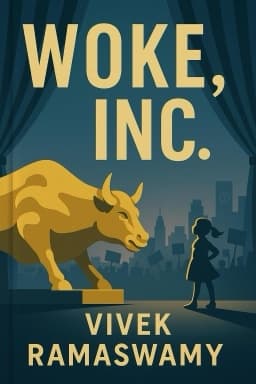
Vivek Ramaswamy
A revealing critique of how corporate wokeness masks self-interest, threatens democracy, and calls for restoring authentic American pluralism.
Vivek Ramaswamy is a biotech entrepreneur who founded Roivant Sciences and has firsthand experience with corporate America.
Section 1
8 Sections
Imagine a grand magic trick unfolding on the stage of corporate America, where the audience is dazzled by the bright lights of social justice and progressive values. At first glance, it appears that corporations have embraced noble causes, championing diversity, equity, and inclusion. Yet beneath this spectacle lies a carefully orchestrated act designed to conceal the true intent: expanding market power and enriching the elite.
Take, for example, the iconic Fearless Girl statue installed facing the formidable Wall Street bull. To the public, she symbolizes female empowerment and the push for gender diversity in leadership. But the statue's true purpose was far more calculated—it was a marketing campaign by a major financial firm promoting an exchange-traded fund focused on companies with women on their boards. This same firm was grappling with internal lawsuits over gender pay disparities, yet instead of addressing these issues directly, it chose to erect a statue that would capture headlines and goodwill.
Stakeholder capitalism, the idea that companies should serve not just shareholders but also employees, communities, and the environment, has become the reigning ideology. In 2018, the Business Roundtable's top corporate leaders publicly committed to this broader mission. On the surface, this seems like a progressive evolution of capitalism. However, it also grants corporations the power to define societal values without democratic input, concentrating influence in the hands of unelected executives and investors.
This dynamic creates a potent illusion: corporations appear to be moral leaders, yet their actions often prioritize market dominance and profit over genuine social progress. The performance is convincing because it taps into widespread desires for justice and inclusion, making it difficult for observers to discern the underlying motives.
As we move forward, it's crucial to recognize this interplay between capitalism and social justice rhetoric. Understanding the 'Goldman Rule' helps us see that financial power shapes not only markets but also moral and cultural norms. This awareness sets the stage for exploring the rise of the managerial class and its implications for both business and democracy.
Let us now delve deeper into the emergence of this influential managerial elite, whose ambitions and actions further complicate the landscape of modern capitalism.
What is the 'Goldman Rule' as described in the context of corporate America?
15 more quizzes available in app
Corporations adopt progressive social values publicly to distract from profit-driven motives and consolidate power.
8 more insights available in app
Unlock all 8 sections, 9 insights, full audio, and interactive mind map in the SnapBooks app.
Unmasking the hidden agenda behind corporate America's embrace of wokeness and the real cost to democracy and society.
Read articleHow a new elite of managers and bureaucrats shape corporations and government beyond shareholder control.
Read article
Jeb Blount

Antoine van Agtmael and Fred Bakker
David Hoffeld
Jeb Blount
