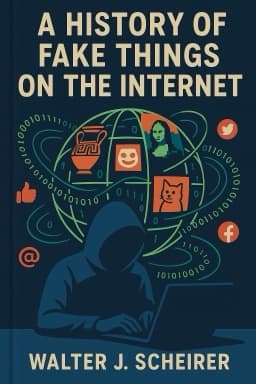
Walter J. Scheirer
An interdisciplinary history revealing how fake digital content shapes culture, creativity, and truth on the Internet.
The hacker 'Quentin' and his UFO story on Dateline NBC was a pioneering example of fake news used as a form of mythmaking.
4 more facts available in the app
Section 1
8 Sections
As we begin our journey into the fascinating world of fake things on the Internet, it’s essential to understand that the impulse to create alternate realities is as old as humanity itself. Long before digital screens illuminated our faces, people told stories—myths—that shaped how societies perceived their world. These myths were not merely fanciful tales; they were frameworks through which complex contradictions and anxieties could be resolved.
Consider the ancient Greeks, who used pottery not only for practical purposes but as a canvas for storytelling. These vases displayed scenes from well-known myths, often reimagined with humor and parody. Imagine an owl dressed as Athena or a satyr comically replacing a hero—early memes that circulated widely among the populace.
Fast forward to the late 20th century, when a new kind of mythmaking emerged from the depths of burgeoning computer networks. A subculture of hackers—young, curious, and creative—began exploring digital frontiers. They did more than break into systems; they crafted elaborate narratives, blending fact and fiction, technical jargon and fantastical elements. One such tale involved a shadowy hacker named Quentin, who appeared on national television, revealing supposed government secrets about UFOs. This was not just deception; it was a performance, a new form of mythmaking that challenged traditional media and engaged a growing digital audience.
These hackers operated in a world where identity was fluid, protected by pseudonyms that allowed them to become characters in their own stories. Their creative exploits were shared through textfiles and bulletin board systems, creating a rich underground literature that invited insiders into secret knowledge. This participatory culture anticipated many of the dynamics we now see on social media, where users remix and reinterpret content continuously.
Understanding this foundation helps us see the Internet not just as a technological marvel but as a digital myth engine, where reality is constantly restyled. From ancient pottery to hacker textfiles, the human desire to craft alternate realities remains a driving force, shaping culture and technology in profound ways.
As we move forward, we will explore how these myths found new expression in the evolving technologies of photographic manipulation, revealing the complex dance between truth and fiction in visual media.
What ancient medium is compared to modern Internet memes?
15 more quizzes available in app
Myth and storytelling have always been central to human culture, shaping perceptions of reality.
8 more insights available in app
Unlock all 8 sections, 9 insights, full audio, and interactive mind map in the SnapBooks app.
Dive deep into the fascinating world where myth, technology, and deception collide on the internet.
Read articleDiscover the surprising connections between ancient storytelling and modern digital fakery.
Read article