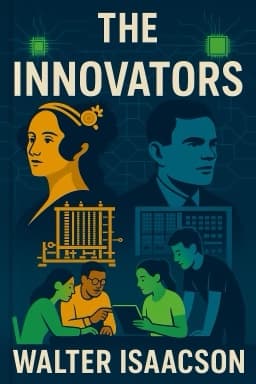
Walter Isaacson
A detailed chronicle of the collaborative pioneers who invented the digital revolution, from early computing to the Internet and personal computers.
Ada Lovelace is often considered the first computer programmer for her work on Babbage's Analytical Engine.
2 more facts available in the app
Section 1
8 Sections
Imagine a young woman in the early 19th century, the daughter of a legendary poet, yet drawn not to verses but to the elegant language of mathematics.
She grasped that this machine could do more than crunch numbers; it could follow instructions, process symbols, and potentially compose music or art. This was a vision far ahead of its time.
Her inspiration partly came from the Jacquard loom, which used punch cards to weave intricate patterns. This analogy illuminated the possibility of programmable machines, where instructions could be fed to a device to perform varied tasks.
Yet Ada's life was marked by paradox: the poetic and the precise, imagination and logic, health struggles and intellectual brilliance. She embodied the spirit of 'poetical science,' a fusion that would characterize much of the digital revolution's creativity.
This beginning sets the stage for the story of computing — not just as a sequence of inventions but as a tapestry woven from imagination, collaboration, and relentless curiosity. From Ada's visionary insights, the journey moves forward into the theoretical foundations that would define what computers could be.
Let us now explore the minds who laid the mathematical and logical groundwork for the machines Ada imagined.
What unique quality did Ada Lovelace bring to early computing?
15 more quizzes available in app
She foresaw the potential of machines beyond calculation to process symbols and create art and music.
8 more insights available in app
Unlock all 8 sections, 9 insights, full audio, and interactive mind map in the SnapBooks app.
Discover the fascinating journey of computing from its poetic beginnings to the dawn of artificial intelligence.
Read articleUnveil surprising facts and hidden stories behind the technology that reshaped our lives.
Read article