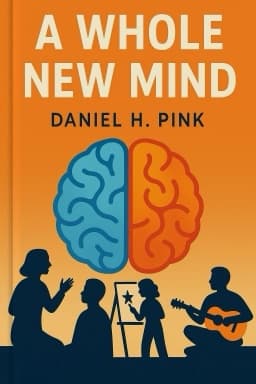
Daniel H. Pink
A guide to mastering right-brain skills like creativity and empathy to succeed in the emerging Conceptual Age.
The concept of right-brain and left-brain thinking is a metaphor inspired by neuroscience but simplified for popular understanding.
Section 1
8 Sections
Imagine a world where the way we think is undergoing a profound transformation. For decades, society has celebrated the left hemisphere of the brain—the logical, analytical, sequential thinker who excels at language, math, and linear problem-solving. This left-brain dominance shaped our education, our workplaces, and even our sense of identity. But beneath the surface, a quiet revolution has been unfolding.
Our brains, weighing about three pounds, are divided into two halves connected by a thick bundle of nerve fibers. While the left hemisphere processes information in a linear, step-by-step fashion, the right hemisphere sees the big picture, recognizes patterns, and interprets emotions. This difference is not just academic; it shapes how we experience the world.
Consider the story of a man lying inside a powerful MRI machine, his brain scanned as he views faces expressing emotions and complex scenes like a man pointing a gun. The scans reveal a fascinating pattern: when viewing faces, the right hemisphere lights up, decoding subtle emotional cues instantly. Yet when assessing the threatening scenes, the left hemisphere takes charge, analyzing details sequentially to understand the danger.
Historically, the left hemisphere was considered the seat of humanity’s unique abilities, primarily because it houses language centers. For centuries, scientists believed the right hemisphere was a silent, less capable remnant. But groundbreaking research, especially on patients whose brain halves were surgically separated to treat epilepsy, revealed the right hemisphere’s surprising capabilities. It excels in tasks like recognizing faces, interpreting tone of voice, and grasping metaphors—skills essential for empathy and creativity.
Yet, popular culture has often distorted these findings. Some have over-glorified the right brain, attributing to it mystical powers, while others cling to the belief that logic and analysis are paramount. The truth lies in balance.
This shift is not just neurological; it is cultural and economic. As routine, rule-based tasks become automated or outsourced, the qualities that machines and distant workers cannot replicate—creativity, empathy, big-picture thinking—are gaining value. The future belongs to those who cultivate these right-brain aptitudes alongside traditional left-brain skills.
As we embark on this journey, we will explore the forces propelling this change, the new skills required, and practical ways to develop a whole new mind. Let us now turn to the powerful social and economic currents shaping this transformation.
Which hemisphere of the brain is primarily responsible for sequential, logical reasoning?
15 more quizzes available in app
The left and right hemispheres process information differently but complement each other.
8 more insights available in app
Unlock all 8 sections, 9 insights, full audio, and interactive mind map in the SnapBooks app.
Unlock the Right-Brain Revolution to Thrive in Today’s Economy
Read articleFrom Left-Brain Logic to Right-Brain Creativity: The Essential Shift
Read article
Ali Abdaal

Dick Schaefer; Pamela Espeland

Robin Sharma

Jeff Haden
