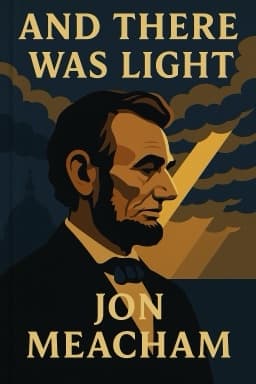
Jon Meacham
A rich, nuanced biography of Abraham Lincoln that explores his moral evolution, leadership during the Civil War, and enduring legacy in the American struggle for freedom and justice.
Lincoln was largely self-educated, reading extensively by himself with limited formal schooling.
Section 1
9 Sections
In the quiet, rugged wilderness of early 19th-century Kentucky, a small log cabin stood as the birthplace of a man whose impact would ripple through history. Born to a family of modest means, Abraham Lincoln’s early life was marked by hardship, uncertainty, and a complex legacy. His mother, Nancy Hanks Lincoln, though surrounded by rumors and social stigma, was the wellspring of his moral compass.
Lincoln’s ancestry was a tapestry woven from the threads of Puritan settlers who had journeyed from England to Massachusetts before venturing westward. This migration mirrored the restless spirit of a young nation expanding its frontiers. Yet, it was not wealth or privilege that defined Lincoln’s childhood but the raw realities of frontier life—backbreaking labor, sparse education, and the ever-present shadow of slavery.
Amid this environment, Lincoln absorbed the teachings of antislavery Baptist preachers whose sermons echoed the biblical injunctions of justice and mercy. These early lessons planted seeds of a moral conviction that would later blossom into a fierce opposition to the institution of slavery. Despite the scarcity of formal schooling, Lincoln’s thirst for knowledge was unquenchable. He taught himself to read and write, often using charcoal to scrawl letters in the dirt or snow, driven by a hunger for understanding that transcended his humble surroundings.
His family’s move from Kentucky to Indiana was partly motivated by a desire to escape the pervasive presence of slavery, seeking a freer life where land was affordable and opportunity beckoned. Yet, even in Indiana, Lincoln’s world was shaped by the tension between the ideals of liberty and the entrenched social realities of race and class.
These formative years were not without personal tragedy. The death of his mother from milk sickness left a void that was only partly filled by the arrival of a stepmother who nurtured his intellectual curiosity. Through these trials, Lincoln developed a resilience and a sense of purpose that propelled him forward.
As we reflect on these early chapters, it becomes clear that Lincoln’s greatness was not born of privilege but forged in the crucible of adversity, shaped by family, faith, and a burgeoning sense of justice.
What influence did Abraham Lincoln’s mother have on him?
17 more quizzes available in app
Lincoln’s modest birth and family struggles laid the foundation for his resilience and ambition.
7 more insights available in app
Unlock all 9 sections, 8 insights, full audio, and interactive mind map in the SnapBooks app.
Discover the lesser-known facets of Lincoln’s humble beginnings and how they shaped one of America’s greatest leaders.
Read articleExplore how Lincoln’s relentless pursuit of knowledge shaped his leadership and the fate of a nation.
Read article