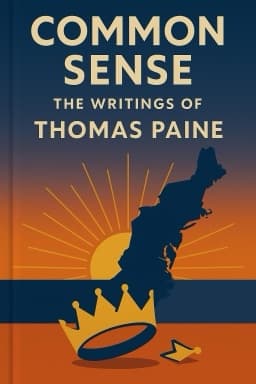
Thomas Paine
A powerful argument for American independence advocating for republican government and the rejection of monarchy.
Thomas Paine wrote 'Common Sense' in just a few weeks in early 1776.
Section 1
8 Sections
Imagine a time when a few settlers find themselves in a vast wilderness, isolated and unconnected to the outside world. Their survival depends not only on their individual strength but on their ability to cooperate.
Government, unlike society, is not a positive force but a necessary evil. It exists to restrain the vices that would otherwise disrupt the harmony of society. It is the badge of lost innocence, a mark that man’s impulses alone are insufficient to maintain order. As the colony grows, it becomes impractical for everyone to meet and decide every matter. Thus, they select representatives to act on their behalf, but with a crucial safeguard: frequent elections.
The English constitution, often lauded, is critiqued here for its complexity and contradictions. The monarchy and aristocracy are hereditary and independent of the people, while the commons, though representing the people, are often overwhelmed by the crown’s power. This imbalance results in a system where the crown holds the true governing weight, sustained by patronage and national pride rather than reason.
Reflecting on this, one sees that the simplest forms of government are often the most stable and repairable. The settlers’ early regulations, enforced by community consensus, are far less prone to disorder than the convoluted structures of monarchy and aristocracy.
Let us now turn to the next chapter, where the story of kings and their claims unfolds, revealing the deep flaws and dangers of hereditary rule.
What is the fundamental difference between society and government as described?
15 more quizzes available in app
Society is a natural union for mutual benefit; government is a human invention to control vice.
6 more insights available in app
Unlock all 8 sections, 7 insights, full audio, and interactive mind map in the SnapBooks app.
Discover how a fiery pamphlet ignited a revolution and reshaped democracy forever.
Read articleExplore the bold concepts and arguments that made 'Common Sense' a revolutionary blueprint.
Read article
F. A. Hayek
Niccolò Machiavelli
Daniel Chandler
Jonah Goldberg
