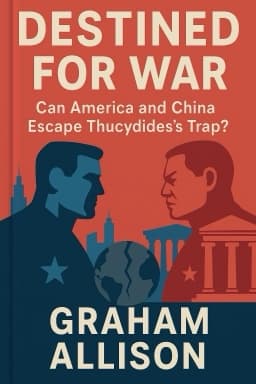
Graham Allison
An insightful analysis of the US-China rivalry through the lens of historical power transitions, warning of war risks but offering paths to peace.
The term 'Thucydides’s Trap' is derived from the ancient Greek historian Thucydides’ explanation of the Peloponnesian War.
2 more facts available in the app
Section 1
10 Sections
Imagine a sleeping giant, vast and ancient, stirring from centuries of slumber. This giant, once a poor agrarian society, has awakened with a force that shakes the very foundations of global power.
The human impact is profound: over half a billion people lifted out of extreme poverty, life expectancy doubling, and literacy reaching 95%. The streets once filled with bicycles now teem with millions of cars, and skylines climb ever higher with skyscrapers built in mere days. This is a nation moving at a breathtaking pace, fueled by a blend of state planning, entrepreneurial vigor, and sheer determination.
But this rise is not just about economics. It is about power and influence. China’s economic might allows it to wield unprecedented geopolitical leverage, creating new financial institutions like the Asian Infrastructure Investment Bank and ambitious projects such as the Belt and Road Initiative to connect continents.
As we begin to explore the dynamics of this power transition, remember that the story of China’s rise is not just a tale of numbers and infrastructure but a profound shift in the balance of power, setting the stage for challenges and opportunities alike.
Let us now turn to the lessons history offers us, where echoes of this modern tale resonate with the struggles of great powers past.
How fast has China's economy doubled since 1980?
19 more quizzes available in app
China's growth has been staggering and transformative.
8 more insights available in app
Unlock all 10 sections, 9 insights, full audio, and interactive mind map in the SnapBooks app.
Explore the explosive dynamic between a rising China and a ruling America, and why history warns us of looming conflict — but also how peace might still be possible.
Read articleFrom Athens vs. Sparta to the Cold War, uncover ten epic power struggles that reveal patterns shaping today's US-China rivalry.
Read article