Robert M. Sapolsky
A comprehensive scientific argument that free will is an illusion, with profound implications for morality and society.
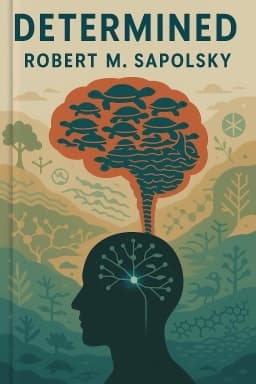
The phrase 'turtles all the way down' illustrates the infinite regress problem in causality.
Section 1
8 Sections
Imagine standing at the edge of a vast ocean of causality, where every wave that laps the shore is preceded by countless others stretching endlessly backward in time. This metaphor of 'turtles all the way down' beautifully captures the essence of determinism — the idea that every event, including our actions, arises from a prior cause, which itself was caused by another, ad infinitum.
Our intuitive belief in free will—that we spontaneously decide our actions independent of past causes—faces a formidable challenge from neuroscience. Experiments measuring brain activity reveal a startling truth: the brain's readiness potential, a pattern of neural activation signaling preparation for movement, occurs hundreds of milliseconds before we consciously feel we have made a decision.
Consider the classic experiment where a person is asked to press a button whenever they feel the urge. While they report the moment of conscious choice, the brain regions responsible for initiating the movement light up well before. This disconnect between neural initiation and conscious awareness shakes the foundation of free will as traditionally conceived.
Yet, despite this scientific insight, society clings to the notion of free will. Why? Because it underpins our ideas of responsibility, justice, and morality. We want to believe that individuals are the authors of their actions and deserve praise or blame accordingly. But the science nudges us to reconsider.
As we journey deeper into understanding human behavior, we must keep in mind that focusing solely on the fleeting moment of conscious choice—the last few seconds before an action—is like trying to understand a novel by reading only its final pages.
In the next section, we will explore the rich tapestry of biology that forms the foundation of our intentions, revealing how our brains and bodies, influenced by genetics, hormones, and experience, create the intentions we mistakenly believe we freely choose.
What does the 'turtles all the way down' metaphor illustrate?
15 more quizzes available in app
Every behavior is caused by prior events, forming an endless causal chain.
8 more insights available in app
Unlock all 8 sections, 9 insights, full audio, and interactive mind map in the SnapBooks app.
Discover how cutting-edge neuroscience challenges the very idea of free will and what it means for our understanding of human behavior.
Read articleExplore the fascinating interplay of biology and culture that forms our intentions long before conscious thought.
Read article
Herman Pontzer, PhD
Lisa Randall
John Hands
Carlo Rovelli
