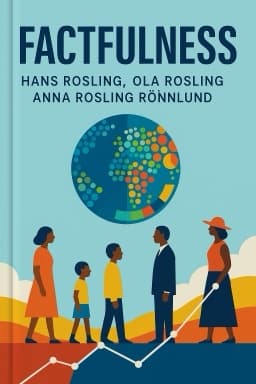
Hans Rosling, Ola Rosling, Anna Rosling Rönnlund
A data-driven guide to overcoming common misconceptions and developing a fact-based, optimistic worldview about global progress.
Hans Rosling was a practicing medical doctor before becoming a global health educator.
Section 1
7 Sections
Imagine a world where everyone talks about 'us and them,' rich and poor, developed and developing. This is a story many of us have heard so often that it feels like an unshakable truth. But what if I told you this story is no longer true? In fact, it's a misconception that clouds our understanding and makes the world seem more divided than it really is.
Let’s take a step back and look at the data. When we examine the global population by income, we find that about 75 percent live in countries that are neither poor nor rich but fall somewhere in the middle. These are places where families have smaller households, children attend school, and access to basic healthcare and clean water is steadily improving. This middle is bustling with progress, opportunity, and complexity. Yet, the labels 'developing' and 'developed' persist, painting a world divided by a chasm that no longer exists.
This binary thinking is what we call the 'gap instinct.' It tempts us to see the world in two separate boxes, with a dramatic gap in between. But this gap is an illusion. When we look closely, we find overlapping ranges of income, health, and education. For example, child mortality rates and family sizes vary smoothly across countries rather than forming two distinct groups.
To understand this better, think of the world divided not into two, but four income levels. Level 1 is where people live on about $1 per day, struggling with extreme poverty. Level 2 is a step up, with basic improvements like access to food and water. Level 3 is where many families live comfortably enough to send children to school and afford some modern conveniences. Level 4 is the wealthy consumer level, familiar to many of us. Most people live on Levels 2 and 3, the middle ground often overlooked.
For example, in 1965, the world did look divided into two groups. But today, the majority have moved into the middle levels. Countries like China and India, once considered poor, now have millions living comfortable middle-class lives. The gap is closing, but our minds and language have not caught up.
Understanding this is key to seeing the world clearly and responding effectively to global challenges. It also helps us appreciate the diversity and resilience of people worldwide. So as we move forward, let’s leave behind the illusion of a divided world and embrace the rich spectrum of human experience. This new perspective sets the stage for exploring other instincts that distort our view of reality.
With this fresh understanding, we can now turn to the next challenge: why do we tend to see the world as getting worse, even when data shows otherwise?
What percentage of the world's population lives in middle-income countries?
13 more quizzes available in app
Our tendency to divide the world into two opposing groups creates a misleading worldview.
8 more insights available in app
Unlock all 7 sections, 9 insights, full audio, and interactive mind map in the SnapBooks app.
Discover how Factfulness shatters common misconceptions and reveals the hopeful reality of our world.
Read articleUncover the seven instincts that distort your worldview and learn how to overcome them with data.
Read article
Neil Postman
Nick Bostrom
Temple Grandin
Steven Pinker
