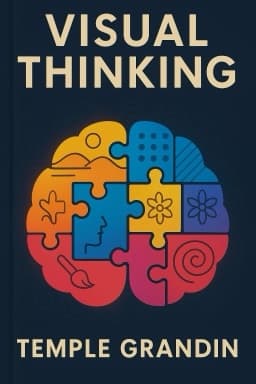
Temple Grandin
An insightful exploration of visual thinking, its challenges in education and industry, and the vital role of neurodiversity in innovation and society.
Temple Grandin’s visual thinking helped revolutionize livestock handling by designing cattle chutes that reduce animal stress.
2 more facts available in the app
Section 1
9 Sections
In the vast landscape of human cognition, two dominant ways of thinking emerge: the verbal and the visual. While verbal thinkers navigate the world through the structured flow of language and sequential logic, visual thinkers immerse themselves in a rich ocean of images, patterns, and abstractions. Imagine the mind as a theater: for verbal thinkers, the play unfolds linearly, each scene following the last in a strict sequence; for visual thinkers, it’s a vivid montage of pictures, shifting and evolving in associative leaps.
Consider the difference between reading a recipe and watching someone cook. The verbal thinker might follow the step-by-step instructions meticulously, while the visual thinker recalls the image of the sizzling pan, the colors of the ingredients, and the rhythm of the cooking process. This difference is not merely preference but rooted in how the brain processes information.
Within visual thinking itself, there are two fascinating subtypes: object visualizers and spatial visualizers. Object visualizers conjure detailed, photorealistic images in their minds. They excel at mechanical tasks, design, and artistic endeavors. Their mental camera captures the world with precision, allowing them to reconstruct and manipulate objects in their imagination. Spatial visualizers, on the other hand, think in terms of patterns and abstract relationships. They excel in mathematics, physics, and computer programming, seeing the underlying structures and connections rather than concrete images.
For example, when presented with a diagram of a folded paper with holes punched in it, object visualizers picture the exact shape and location of the holes, while spatial visualizers manipulate the abstract spatial relationships and transformations involved. Both styles are essential, complementing each other in fields like engineering, where the object visualizer builds the machine and the spatial visualizer writes the code that makes it run.
As we journey further, we will explore how these thinking styles interact with education, industry, and collaboration, revealing hidden gifts and challenges along the way.
What best describes visual thinking?
17 more quizzes available in app
People primarily think either in images or in words, shaping how they perceive and solve problems.
8 more insights available in app
Unlock all 9 sections, 9 insights, full audio, and interactive mind map in the SnapBooks app.
Discover the transformative power of visual thinking and why our education system must evolve to nurture every kind of mind.
Read articleA deep dive into the educational blind spots that exclude visual learners and the urgent reforms needed to save innovation and industry.
Read article
Neil Postman
Nick Bostrom
Steven Pinker
Steven Rosenbaum
