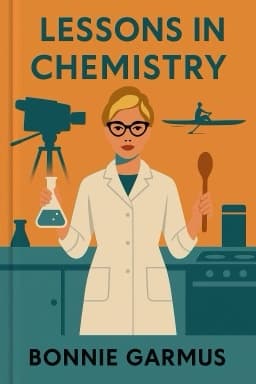
Bonnie Garmus
A brilliant chemist battles sexism and personal loss to become an empowering TV cooking show host in 1960s America.
The character Elizabeth Zott was inspired by real women scientists who faced discrimination in the mid-20th century.
Section 1
7 Sections
In the opening chapters, we meet Elizabeth Zott, a brilliant chemist whose life is a testament to resilience in the face of relentless adversity.
The narrative also introduces us to Calvin Evans, a fellow scientist whose brilliance and complexity complement Elizabeth’s own. Their initial clash over stolen beakers evolves into a partnership both intellectual and emotional. Their relationship offers a glimpse of hope and mutual respect in a world often hostile to women like Elizabeth.
Elizabeth’s experience highlights the systemic nature of gender bias: from being reassigned to menial tasks to enduring workplace gossip and sabotage. Yet, it is her refusal to apologize for standing her ground that marks her as a revolutionary figure. Her story reminds us that progress is often forged through the courage to confront injustice head-on.
As we close this section, we prepare to follow Elizabeth’s unexpected transition from the lab to the television studio, where her unique blend of science and cooking will challenge societal norms in new and surprising ways. This shift marks the beginning of a new chapter in her life, one that will amplify her voice and influence far beyond the laboratory walls.
What major challenge did Elizabeth face early in her scientific career?
13 more quizzes available in app
The entrenched gender bias in the scientific community limited women’s opportunities and recognition.
7 more insights available in app
Unlock all 7 sections, 8 insights, full audio, and interactive mind map in the SnapBooks app.
Unpacking the inspiring journey of Elizabeth Zott, a chemist who defied the odds and changed the narrative for women in science and beyond.
Read articleDiscover the unexpected ways a 1960s cooking show challenged gender norms and empowered women through science and authenticity.
Read article
John Fusco
Kurt Vonnegut Jr.
Mark Twain
John Boyne
