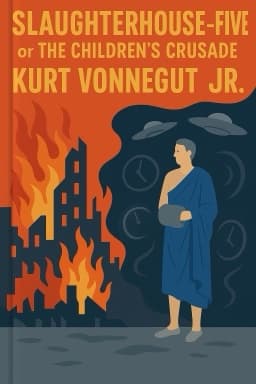
Kurt Vonnegut Jr.
A nonlinear, satirical exploration of war's horrors through the time-traveling eyes of a WWII POW.
Kurt Vonnegut drew heavily on his own experiences as a prisoner of war during the Dresden bombing to write Slaughterhouse-Five.
Section 1
6 Sections
Imagine a city, once vibrant and full of life, suddenly engulfed in flames so fierce they turn the night sky into a hellish glow. This is not a distant fantasy but a brutal reality that thousands faced during one of the most devastating bombings in history. The city of Dresden, known for its beauty and culture, was reduced to ashes in a firestorm that claimed tens of thousands of innocent lives.
One unforgettable figure was a cab driver who, despite his losses and the hardships of living under a harsh regime, maintained a hopeful outlook for peace and freedom. His simple wish for a world of peace, expressed in a humble postcard, resonates deeply.
The narrative does not shy away from the grim realities: the cold, the hunger, the fear, and the constant presence of death. Yet, it also reveals the absurdity and irony that permeate war. Soldiers clinging to trivial souvenirs, the surreal moments of laughter in the face of death, and the repeated phrase, 'So it goes,' serve as a mantra of acceptance and a coping mechanism against the incomprehensible.
In reflecting on these events, we realize that war's impact extends far beyond the battlefield. It reshapes cities, scars souls, and challenges the very fabric of morality. This understanding sets the stage for exploring how individuals navigate time and memory in the aftermath, leading us to our next profound insight.
Let us now journey beyond the physical destruction to the labyrinth of time itself, where past, present, and future intertwine in unexpected ways.
What event does the novel center around as a symbol of war's horror?
11 more quizzes available in app
War brings destruction beyond battlefields, affecting innocent civilians and leaving lasting scars.
7 more insights available in app
Unlock all 6 sections, 8 insights, full audio, and interactive mind map in the SnapBooks app.
Unpacking the haunting, nonlinear tale that reshaped war literature forever
Read articleExploring the fractured mind through Vonnegut’s unique storytelling lens
Read article