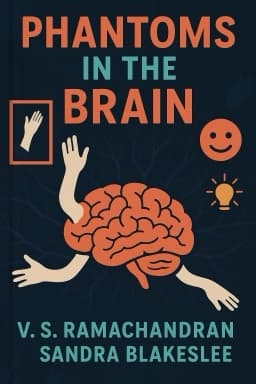
V.S. Ramachandran, M.D., Ph.D., and Sandra Blakeslee
Exploring neurological mysteries, brain plasticity, and the nature of self through fascinating patient cases and scientific inquiry.
The brain contains over 100 billion neurons, with each neuron making thousands of connections.
Section 1
9 Sections
Imagine waking up one morning convinced that your arm is still there, even though it was amputated weeks ago. This is not a hallucination or a trick of the mind but a profound neurological phenomenon known as the phantom limb.
One striking example involves a patient who lost his left arm but felt his phantom fingers move and itch. When his cheek was stroked, he felt the sensation both on his face and phantom hand. This dual sensation arose because the face area in the brain had expanded into the territory once occupied by the hand. The brain was essentially rewiring itself.
Moreover, the phantom limb is not just a sensory illusion. Many patients can voluntarily move their phantom limbs, reaching out or grasping objects, even though no physical limb exists. This shows that motor commands from the brain continue to operate as if the limb were present.
Therapeutically, these insights have led to innovative treatments like mirror therapy, where patients use the reflection of their intact limb to 'trick' the brain into perceiving movement and presence in the phantom limb. This can alleviate pain and restore function, highlighting the brain’s remarkable capacity for self-healing.
As we begin to understand the brain’s complex body maps and their ability to adapt, we open the door to exploring how perception and consciousness arise from these neural circuits. The journey ahead takes us into the fascinating territory of how the brain constructs reality itself, which we will explore next.
What happens to the brain’s sensory map after a limb is amputated?
17 more quizzes available in app
The brain’s ability to create sensations of missing limbs reveals its complex body mapping and plasticity.
8 more insights available in app
Unlock all 9 sections, 9 insights, full audio, and interactive mind map in the SnapBooks app.
Discover how the brain’s remarkable ability to rewire itself creates sensations of limbs that no longer exist—and what this means for healing and human perception.
Read articleHow can some blind people navigate obstacles without seeing them? Dive into the brain’s dual visual streams that separate perception from action.
Read article