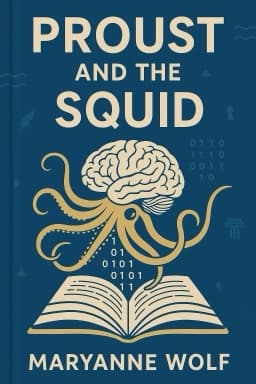
Maryanne Wolf
An interdisciplinary journey into the evolution, development, and neuroscience of the reading brain and literacy.
The squid’s giant axon, studied in the 1950s, helped scientists understand how neurons transmit signals, inspiring part of the book's title.
Section 1
10 Sections
Imagine a world before books, before words on paper, where humans communicated only through speech and gesture.
Our brains, evolved for survival tasks such as recognizing faces and objects or processing spoken language, had to be remarkably flexible. This flexibility, known as brain plasticity, allowed ancient humans to repurpose existing circuits for a new task: reading. This process is called neuronal recycling, where older brain regions specialized for object recognition are adapted to decode letters and words. This adaptation is not trivial; it requires the brain to form new connections and pathways every time a child learns to read.
Consider how the visual system is organized. Each neuron in the retina corresponds to a specific area in the occipital lobe, creating a precise map of what we see. This retinotopic organization enables rapid and specialized processing of visual information. When ancient humans first saw tokens or symbols, their brains linked these visual patterns to meanings and sounds, setting the stage for the complex reading systems to come.
Reading’s origin is a tale of human ingenuity and brain adaptability. From tokens to pictographs, to syllabaries and alphabets, each step demanded new cognitive breakthroughs and brain adaptations. This story also foreshadows the challenges faced by children today as they learn to read, a process still requiring intense brain work and environmental support.
As we move forward, we will explore how these writing systems evolved and how the brain’s remarkable plasticity enabled humans to master reading, shaping our intellectual history and future. The next section delves into the birth of the alphabet and the profound cultural shifts it unleashed.
What is the key reason reading is considered a cultural invention?
19 more quizzes available in app
Reading is not innate but requires brain plasticity to adapt older circuits.
8 more insights available in app
Unlock all 10 sections, 9 insights, full audio, and interactive mind map in the SnapBooks app.
Discover the astonishing neuroscience behind how our brains adapt to reading and why it’s more magical than you think.
Read articleWhy dyslexia isn’t a disorder but a different way of thinking — and how it can be a source of creativity and innovation.
Read article