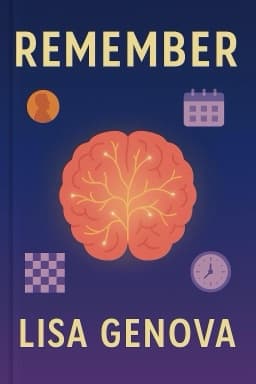
Lisa Genova
A comprehensive guide to understanding, managing, and improving human memory from neuroscience to practical strategies.
The average adult knows between 20,000 to 100,000 words stored in semantic memory.
Section 1
9 Sections
Imagine standing on the edge of a vast ocean of memories, each wave representing a moment, a feeling, a fact, or a skill you've learned. What makes this ocean so vast, so deep, and so uniquely yours? It is the miraculous process by which your brain transforms fleeting experiences into lasting memories.
Consider a warm summer evening at your favorite beach. You see your children playing soccer, hear a favorite song playing softly, smell the salty ocean air mixed with the scent of a bonfire, taste fresh oysters and sweet s’mores, and feel happiness radiating through you. These sensory and emotional fragments, initially separate, are woven together by a remarkable structure deep in your brain called the hippocampus.
This process unfolds in four stages: encoding, where sensory input is translated into neural signals; consolidation, where these signals are linked into a stable network; storage, where the memory is maintained across various brain areas; and retrieval, where the memory is reactivated and experienced again.
Our brains are astonishing in their capacity. Just think of Akira Haraguchi, who memorized over 111,000 digits of pi at age 69, or chess masters who hold knowledge of thousands of moves. Yet, this vast capacity is not limitless in the sense of physical space but through the complex and distributed nature of neural connections. Memories are not stored in a single location but across the brain regions that initially processed each aspect of the experience — vision, sound, smell, emotion — all linked by the hippocampus.
So, your memory is not a video recording but a living, breathing network of associations. When you recall a memory, you are activating this network, reliving the moment through the interplay of neurons.
Understanding how memory is formed and stored opens the door to appreciating its strengths and limitations. It shows us that memory is not just a passive archive but an active, dynamic process that shapes who we are.
As we move forward, we’ll delve into the vital role of attention in memory formation — how what we choose to notice becomes what we remember — and the fleeting nature of our present moment memory, the working memory, that acts as the gateway to our long-term memories. Let’s explore how being truly 'in the moment' can transform our ability to remember.
What is the role of the hippocampus in memory?
17 more quizzes available in app
Memories are created through encoding, consolidation, storage, and retrieval stages involving multiple brain regions.
8 more insights available in app
Unlock all 9 sections, 9 insights, full audio, and interactive mind map in the SnapBooks app.
Discover the fascinating science behind your memories and why forgetting is actually a superpower.
Read articleForgetfulness isn’t your brain failing; it’s your brain working smart. Learn how to hack your memory today!
Read article