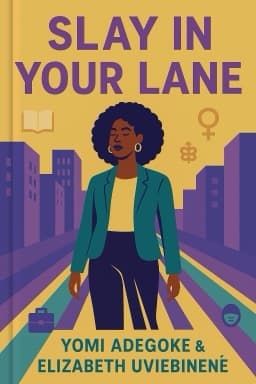
Yomi Adegoke & Elizabeth Uviebinené
An empowering guide exploring the challenges and triumphs of black British women in education, work, relationships, and health.
Slay in Your Lane was inspired by the authors' own experiences and a desire to fill a gap in literature about black British women's lives.
Section 1
8 Sections
Education is often seen as the great equalizer, a path to opportunity and success. But for many black girls growing up in the UK, the educational journey is layered with unseen obstacles that challenge their potential at every turn.
Imagine a classroom where a young black girl diligently raises her hand to answer a question, only to be overlooked because the teacher unconsciously assumes her capabilities are limited. This is not an isolated incident but a reflection of widespread patterns documented in studies revealing that black students, particularly girls, are frequently underestimated.
Moreover, disciplinary practices exacerbate these challenges. Black children are nearly four times more likely to be suspended than their white peers. This disproportionate punishment is not just a statistic but a lived reality that disrupts learning and fosters alienation. For black girls, this means navigating a school environment where minor infractions are met with severe consequences, while similar behaviors by others might be excused.
Parental expectations play a dual role. On one hand, families often hold high aspirations, encouraging their children to pursue professions like law, medicine, or engineering—fields perceived as stable and respected. On the other hand, these expectations add pressure, especially when the school environment does not provide adequate support. Parents’ emphasis on education as a route to security is a powerful motivator, yet it also highlights the disconnect between home encouragement and institutional readiness to nurture black girls’ talents.
Role models—or the lack thereof—further influence educational outcomes. The scarcity of black teachers and culturally relevant curricula means black girls rarely see themselves reflected in the educational content or staff. This absence can diminish their engagement and limit their vision of what is possible.
Despite these challenges, black girls demonstrate remarkable resilience. Many develop strategic approaches to navigate the system, choosing alternative routes to success such as attending different institutions or supplementing their education through tutoring and community programs. Their stories are not just about struggle but about agency and determination.
As we reflect on these realities, it becomes clear that addressing educational disparities requires more than acknowledging statistics; it demands systemic change, cultural competency training for educators, and inclusive curricula that celebrate black histories and contributions.
Understanding these foundational experiences in education opens the door to exploring how these early challenges translate into the workplace, where black women continue to face hurdles. Let’s move forward to uncover the complexities of work life and the concrete ceilings that await.
What is a significant factor affecting black girls’ academic performance in UK schools?
15 more quizzes available in app
Biases and stereotypes affect black girls’ schooling experience and outcomes.
8 more insights available in app
Unlock all 8 sections, 9 insights, full audio, and interactive mind map in the SnapBooks app.
Discover the hidden educational challenges black British girls face and the resilience that fuels their success.
Read articleExplore the invisible barriers in the workplace and the relentless ambition fueling black women’s careers.
Read article
Neil Postman

Nick Bostrom

Temple Grandin

Steven Pinker
