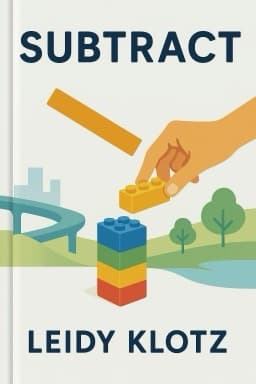
Leidy Klotz
An exploration of why humans neglect subtraction in favor of addition, revealing how embracing less can lead to better change in life, systems, and the planet.
The Embarcadero Freeway removal in San Francisco led to a 50% increase in housing and 15% increase in jobs around the waterfront.
2 more facts available in the app
Section 1
6 Sections
Imagine a child and an adult, both faced with a simple challenge: to build a Lego bridge that is level. The adult instinctively reaches for a block to add to the shorter side, while the child quietly removes a block from the taller side. This simple moment reveals a profound truth about human cognition: we are wired to add, not subtract.
Across a wide range of experiments, this tendency holds firm. Whether people are asked to improve musical notes, rewrite sentences, or simplify recipes, they prefer to add rather than remove. Even in abstract tasks where the physical effort of adding or subtracting is identical, such as clicking squares on a computer screen, people add far more often than they subtract.
Why does this happen? Our brains prioritize mental efficiency. Ideas that come to mind easily are more likely to be acted upon. Adding is more accessible because it is often associated with growth, progress, and competence. Subtraction, on the other hand, requires us to consider loss, removal, and sometimes the undoing of previous efforts—concepts that are less comfortable and less immediately rewarding.
Yet, the power of subtraction is undeniable. In the example of the Lego bridge, removing a block from the taller side is a faster and more elegant solution than adding to the shorter side. This principle applies far beyond toys: in urban planning, business, personal productivity, and environmental sustainability, subtractive changes can lead to greater improvements with less effort.
As we begin this journey into the science of less, remember this: the next time you face a problem, pause and ask yourself not only what you can add, but also what you might take away.
With this foundation laid, we will now explore the deep biological and cultural roots of our preference for more, and how they shape our world in ways both visible and hidden.
In studies where people were asked to modify Lego structures, what percentage typically chose to add blocks rather than remove them?
11 more quizzes available in app
People tend to overlook subtraction as a way to improve situations, favoring addition even when it is less efficient or effective.
7 more insights available in app
Unlock all 6 sections, 8 insights, full audio, and interactive mind map in the SnapBooks app.
Neil Postman
Nick Bostrom
Temple Grandin

Steven Pinker
