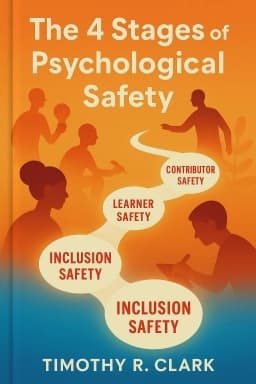
Timothy R. Clark
A practical guide to fostering psychological safety in organizations through four developmental stages, unlocking inclusion, learning, contribution, and innovation.
Google's Project Aristotle identified psychological safety as the single most important factor in team performance.
2 more facts available in the app
Section 1
10 Sections
Imagine stepping into a room where you are instantly seen—not for your job title, your ethnicity, or your beliefs—but simply for the fact that you are a human being. This moment of acceptance, free from judgment or precondition, is the essence of
Consider the story of a young child entering kindergarten for the first time. The natural instinct is to include, to invite others to join in play and friendship. But as we grow, society teaches us to exclude—to judge, to categorize, to erect barriers based on arbitrary distinctions. This shift is tragic because it denies our deepest need: to belong. Studies reveal that nearly two-thirds of college students report feeling very lonely, a stark reminder that inclusion is not just a nicety but a vital human necessity.
Inclusion safety is not about tolerating differences or pretending they do not exist. It is about embracing others with open hearts and minds, recognizing our common humanity above all else. This acceptance should not be conditional, based on performance or conformity, but unconditional and enduring. Yet, the reality is that inclusion can be revoked, sometimes subtly, when individuals no longer fit the expected mold or fail to contribute in expected ways. Such revocation wounds deeply, undermining confidence and silencing voices.
True inclusion safety requires courage and intention. It demands that we challenge our biases and prejudices, that we resist the seductive stories of superiority that divide us. It asks us to extend fellowship even when it feels inconvenient or uncomfortable. When we do so, we activate the best parts of ourselves and create fertile soil for trust, collaboration, and growth.
This journey begins with recognizing that inclusion safety is a right owed to every person. It is the first step on the path to psychological safety, setting the stage for learning, contribution, and innovation. As we move forward, we will explore how this foundation supports the human need to grow and learn, even in the face of fear and uncertainty. Let us now turn to the next stage, where safety to learn opens the door to transformation.
What is the essence of inclusion safety?
19 more quizzes available in app
Inclusion safety is a non-negotiable right granted to all humans based on their inherent worth, not on external attributes or achievements.
8 more insights available in app
Unlock all 10 sections, 9 insights, full audio, and interactive mind map in the SnapBooks app.
Discover how creating a safe space at work can revolutionize your team’s performance and innovation.
Read articleUncover the common pitfalls leaders face and discover proven strategies to build truly safe and high-performing teams.
Read article