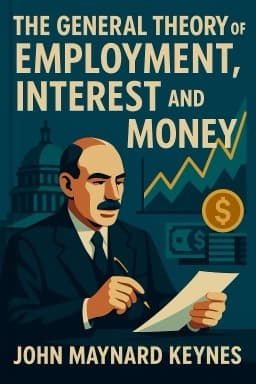
John Maynard Keynes
A revolutionary economic theory arguing that aggregate demand drives employment and advocating government intervention to stabilize economies.
Keynes originally wrote The General Theory to be controversial and knew it would provoke debate among economists.
Section 1
6 Sections
Imagine a world shaken to its core by economic despair, where millions faced unemployment and hopelessness, and the very foundations of economic thought seemed to crumble beneath the weight of reality. It was in this crucible of the Great Depression that a new voice emerged, one that dared to question the long-held belief that markets would always self-correct. This voice belonged to a man whose life was a tapestry woven from both the halls of academia and the corridors of power. His early years as a civil servant and financial advisor gave him a practical lens through which to view the economic chaos unfolding around him.
The Great Depression was not just a backdrop but a catalyst, exposing the fatal flaws in classical economics that had dominated for over a century. The assumption that wage flexibility alone could restore full employment was shattered as unemployment soared to unprecedented heights — 25% in the United States and even higher elsewhere. This relentless crisis demanded a fresh perspective, one that saw beyond the invisible hand and recognized the real human suffering caused by economic downturns.
Our thinker, deeply embedded in the intellectual tradition of Cambridge, was also a man of the world — a financier, an advisor, a public intellectual. His unique vantage point allowed him to bridge theory and practice, leading him to formulate ideas that would soon revolutionize economic thought. He understood that the economy was not a perfect machine but a living system, prone to failure and in need of careful stewardship.
As he observed the crumbling markets and faltering governments, he began to see that the key to economic health lay not in the price of labor alone, but in the total demand for goods and services — aggregate demand. This insight formed the cornerstone of a new economic paradigm that would challenge the old guard and offer hope to a world in crisis.
From this foundational understanding, we embark on a journey through the core ideas that reshaped economics forever. But before we delve into the mechanics of these ideas, it is essential to appreciate the context and the man who dared to envision a different future — a future where governments could play a vital role in healing economic wounds. Let us now turn to the heart of this new theory, where employment, demand, and government intervention intertwine to form a lifeline for struggling economies.
What major event influenced Keynes to challenge classical economics?
11 more quizzes available in app
The Great Depression exposed the limitations of prevailing economic theories and demanded new thinking.
7 more insights available in app
Unlock all 6 sections, 8 insights, full audio, and interactive mind map in the SnapBooks app.
Discover the revolutionary ideas that reshaped economic thought and continue to influence global policies today.
Read articleUnderstanding the pivotal role of aggregate demand in shaping employment and economic cycles.
Read article
Kate Raworth
Roger Bootle
Raghuram Rajan
Nouriel Roubini
