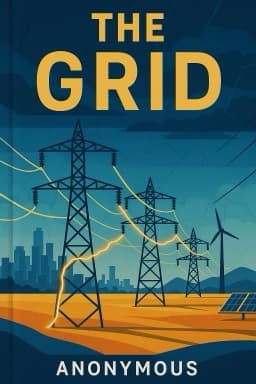
Author not explicitly named in the text
A comprehensive examination of the American electrical grid's history, challenges, and transformative future towards a resilient, sustainable energy system.
The average age of American power plants is over 30 years, contributing to grid vulnerabilities.
2 more facts available in the app
Section 1
9 Sections
Imagine electricity as an invisible, powerful force coursing through the veins of our modern world. Unlike water or air, it is not a substance that flows in a pipe or drifts in the breeze. Instead, electricity is a dance of electrons, atomic particles charged with energy, moving through metal wires at nearly the speed of light. Yet, paradoxically, these electrons themselves drift slowly, about the speed of cold honey.
This immediacy creates a delicate balancing act. Every moment, grid operators must ensure that the amount of electricity produced matches exactly the amount consumed. Too little power and lights dim or go out; too much power and equipment can be damaged. Voltage, the electrical tension or 'desire' of electrons to flow, must remain steady to keep machines running safely. Think of voltage as the push behind the electrons, measured in volts — a steady push is essential, as too strong a push can burn out bulbs, while too weak a push causes dimness and malfunction.
The grid itself is a vast, interconnected system composed of power plants that generate electricity from coal, natural gas, nuclear fuel, wind, or sun; transmission lines that carry high-voltage current across states; transformers that step voltage up or down; and distribution networks that deliver power to homes and businesses. This enormous machine hums quietly around us, rarely noticed, yet utterly indispensable.
Electricity’s nature — a force that must be made and used instantly — means that the grid is fundamentally different from other infrastructure like water or gas pipelines. While water can be stored in reservoirs and gas can be stockpiled, electricity flows only when there is a demand. This means that the grid is a just-in-time system, where supply and demand must be perfectly synchronized.
This section sets the stage for understanding the grid’s challenges and innovations. The invisible force of electricity powers our lives, but its unique physical properties demand extraordinary coordination and infrastructure. As we move forward, we will explore how this complex system developed historically, how it faces new pressures, and how it is being transformed for the future.
Let us now journey into the grid’s history, where invention, competition, and consolidation shaped the electrical landscape we know today.
What is electricity best described as?
17 more quizzes available in app
Understanding electricity's nature is key to grasping the grid's complexity.
8 more insights available in app
Unlock all 9 sections, 9 insights, full audio, and interactive mind map in the SnapBooks app.
Unveiling the hidden vulnerabilities of the electrical grid and how innovative technologies are reshaping our energy future.
Read articleFrom a chaotic web of wires to a sophisticated, interconnected network – the fascinating evolution of the electrical grid.
Read article
Neil Postman
Nick Bostrom
Temple Grandin
Steven Pinker
