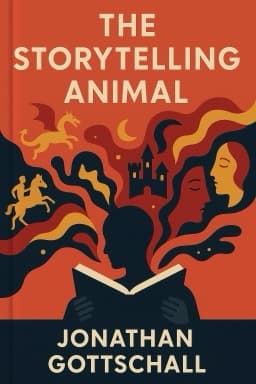
Jonathan Gottschall
An exploration of storytelling as a fundamental human trait that shapes our minds, morals, and societies, from ancient myths to modern digital narratives.
The 'infinite monkey theorem' was tested with macaques who preferred the letter 's' when randomly hitting keys.
Section 1
7 Sections
Stories are not just words on a page or flickering images on a screen; they are the very essence of what it means to be human. From the moment we are born, we are drawn into a world of imagination.
Our brains are wired to respond to stories in profound ways. When we read or watch a story, mirror neurons fire, allowing us to experience the emotions and sensations of the characters.
Consider the curious case of the infinite monkey theorem, tested with real monkeys who preferred hitting the letter 's' repeatedly rather than producing meaningful text. This illustrates that creativity and storytelling are not products of randomness but of a unique cognitive architecture.
Our journey into the heart of storytelling has just begun, but already we see that stories are more than mere entertainment. They are a fundamental part of our nature, a lens through which we understand ourselves and the world. As we move forward, we will explore how stories are structured, why conflict is central, and how our minds simulate life’s challenges through narrative. Let us now step deeper into the universal grammar of stories, where the skeleton of every tale is revealed.
What is one reason children naturally engage in storytelling?
13 more quizzes available in app
Humans are born with a natural craving for stories, evident from early childhood.
8 more insights available in app
Unlock all 7 sections, 9 insights, full audio, and interactive mind map in the SnapBooks app.
Unlocking the profound influence of storytelling on our minds, societies, and future.
Read articleDive deep into the neuroscience behind why stories captivate and heal us.
Read article
Neil Postman
Nick Bostrom
Temple Grandin
Steven Pinker
