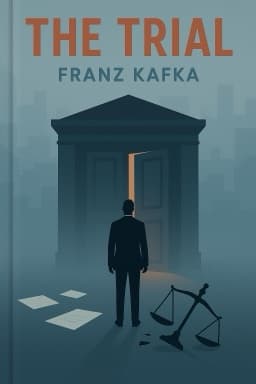
Franz Kafka
A haunting exploration of a man’s struggle against an opaque and oppressive judicial system, revealing the absurdity of bureaucracy and existential despair.
Kafka requested that all his unpublished manuscripts be destroyed after his death, but his friend Max Brod ignored this wish, allowing Kafka's works to become famous.
Section 1
7 Sections
Imagine waking up on an ordinary morning, the routine rhythm of your life unbroken, when suddenly you find yourself thrust into a bewildering nightmare.
Josef K. awakens to a world turned upside down. His landlady's cook, who faithfully brings his breakfast every day, fails to appear. The quiet, familiar surroundings are disrupted by the arrival of two men in black jackets — guards whose purpose is unclear, whose authority is unquestioned. They enter his home without explanation, turning his private space into a stage for an unknown drama.
In this scene, the mundane becomes surreal. The guards discuss the disposal of K.'s possessions, revealing a corrupt system where personal belongings are pilfered and sold off, a metaphor for the erosion of individual rights. K. tries to assert his dignity, to understand the reasons for his arrest, but is met with evasions and dismissals. The guards claim they act under the law, yet the law itself remains a shadowy presence, known only to them in fragments and half-truths.
The old woman across the street watches with senile curiosity, a silent witness to the unfolding farce. This image evokes the sense that society, too, is complicit in the spectacle — observers who neither intervene nor fully comprehend the injustice.
Josef K.'s struggle to maintain composure and control in this moment is a poignant reflection of human resilience. Despite the absurdity and powerlessness of his situation, he resolves not to let the moment slip away, to play along with the farce rather than be crushed by it.
As the day progresses, K. finds himself caught in a web of contradictory messages and unclear authority. He is told he is under arrest, yet free to continue his daily life, including going to work. This paradox illustrates the surreal logic of the system — a place where rules exist but are applied arbitrarily, where freedom and captivity coexist uneasily.
The guards’ behavior oscillates between roughness and a strange kind of camaraderie, highlighting the blurred lines between oppressor and fellow human. K.'s attempts to negotiate, to demand a warrant, to understand his predicament, are met with condescension and dismissal, underscoring the gulf between individual and institution.
This opening section reveals the novel’s core themes: the intrusion of incomprehensible authority into private life, the erosion of personal autonomy, and the beginning of profound alienation.
In this way, the narrative invites us to reflect on the fragility of our own sense of security and the often invisible forces that govern our lives. The arrest is both a literal event and a metaphor for the existential condition — the sudden loss of certainty and the struggle to find footing in a shifting landscape.
As we move forward, we will see how Josef K. navigates this bewildering world, encountering a cast of characters who embody different facets of the court and society, each encounter deepening his sense of isolation and confusion. The journey ahead is as much inward as outward, a passage through the labyrinth of bureaucracy and self-doubt.
Let us now turn to the next chapter, where Josef K. begins to confront the social and personal consequences of his arrest, seeking understanding and connection in a world that seems determined to deny him both.
What is unusual about Josef K.'s arrest?
13 more quizzes available in app
Life can be shattered without warning by forces beyond our understanding.
7 more insights available in app
Unlock all 7 sections, 8 insights, full audio, and interactive mind map in the SnapBooks app.
Dive into the surreal world of Kafka’s The Trial and discover why its chilling depiction of bureaucracy and alienation remains eerily relevant today.
Read articleExplore the thematic core of Kafka’s The Trial and its profound critique of justice, guilt, and existential absurdity.
Read article