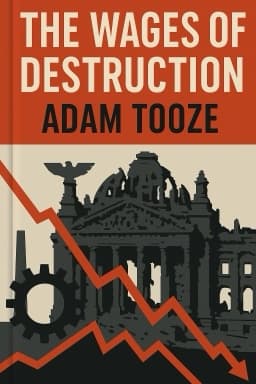
Adam Tooze
An in-depth economic history of Nazi Germany that links ideology, economic strategy, and war to explain the rise and fall of the Third Reich.
Adam Tooze challenges the myth of Germany’s economic superiority before WWII, showing it was more average compared to other European powers.
2 more facts available in the app
Section 1
8 Sections
As we embark on this journey through the economic and ideological labyrinth of Nazi Germany, it is essential to begin with the fragile foundations upon which the Third Reich was built. The Germany of the 1920s and early 1930s was a nation wrestling with the scars of defeat and the upheavals of hyperinflation.
The Weimar Republic, struggling to stabilize the nation, placed its hopes on economic diplomacy. Gustav Stresemann, a figure of pragmatic vision, sought to secure Germany’s future through financial cooperation with the United States and the restructuring of reparations via the Dawes Plan. This plan temporarily eased Germany’s burden, enabling it to borrow heavily from American banks to pay reparations to France and Britain, who in turn used these funds to repay their debts to the United States.
However, the Great Depression shattered this delicate balance. As American loans dried up, unemployment soared, and social unrest spread, the Weimar Republic’s political fabric began to unravel. Extremist parties, including the National Socialists, capitalized on the despair. Here, the stark contrast between Stresemann’s vision and that of Adolf Hitler becomes clear. Stresemann believed in economic integration and peaceful revisionism, while Hitler’s ideology was rooted in racial struggle, the quest for Lebensraum, and a rejection of cooperation with Western powers.
Hitler’s worldview was shaped by a sense of embattlement and apocalypse. He saw the rise of the United States not as an opportunity for partnership but as an existential threat, orchestrated by a Jewish conspiracy.
Understanding this turbulent economic backdrop and ideological clash is crucial as we move forward. It sets the stage for the dramatic transformation of Germany’s economy under Nazi rule and the catastrophic consequences that followed. Let us now delve into the early years of the Nazi regime, where economic recovery was promised, but the true priorities lay elsewhere.
What was the real economic status of Germany in the 1930s compared to other nations?
15 more quizzes available in app
The economic turmoil of the 1920s and early 1930s destabilized the Weimar Republic and created fertile ground for extremist ideologies.
8 more insights available in app
Unlock all 8 sections, 9 insights, full audio, and interactive mind map in the SnapBooks app.
Unveiling the Real Economic Forces Behind Hitler’s Rise and the Nazi War Machine
Read articleThe Dark Economic Engines Behind the Holocaust and the Nazi War Effort
Read article