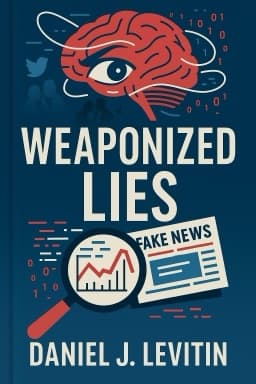
Daniel J. Levitin
A comprehensive guide to critical thinking, teaching how to detect and counter misinformation in the data-driven, post-truth world.
The phrase 'weaponized lies' describes misinformation deliberately crafted to deceive and manipulate.
Section 1
9 Sections
In a world saturated with numbers, we often accept statistics as cold, hard facts. But the truth is, numbers are human constructs, subject to interpretation and error. Before diving deep into data, one of the most powerful tools we have is plausibility checking — a simple, intuitive way to ask, 'Does this make sense?' Imagine hearing that marijuana smokers in California have doubled every year for thirty-five years. At first, it might sound impressive, but a quick mental calculation reveals an absurdity: doubling every year would mean more smokers than the entire world population many times over. This is not just implausible; it’s impossible. This example teaches us that even without advanced math, a little common sense can expose falsehoods.
Similarly, consider a telemarketer boasting about making 1,000 sales a day. If each call takes at least a minute, including dialing, pitching, and processing payment, the maximum achievable sales in an eight-hour workday is closer to 480. The claim, while catchy, cannot stand up to scrutiny. These insights remind us that numbers must be grounded in reality.
Another subtle trap lies in the difference between percentage points and percentages. When interest rates rise from 3% to 4%, that's a 1 percentage point increase but a 33% relative increase because the base was 3%. Misunderstanding this can lead to overestimating or underestimating changes in financial or statistical data. By mastering these simple checks, we build a foundation for deeper critical thinking.
Why is the claim that marijuana smokers doubled every year for 35 years impossible?
17 more quizzes available in app
Use common sense and simple math to quickly assess whether numerical claims make sense.
8 more insights available in app
Unlock all 9 sections, 9 insights, full audio, and interactive mind map in the SnapBooks app.
Discover the hidden tricks behind everyday numbers and learn to see through the smoke and mirrors of statistics.
Read articleUnmask the visual and verbal tactics that distort statistics and learn to protect yourself from misinformation.
Read article
Bryan Stevenson

Joseph Henrich

Katherine Zoepf
Robert Whitaker
