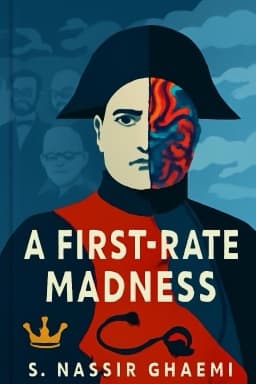
S. Nassir Ghaemi
Mental illness can enhance leadership qualities, making some of history’s greatest leaders uniquely effective in times of crisis.
William Tecumseh Sherman, a Civil War general, likely suffered from bipolar disorder.
2 more facts available in the app
Section 1
7 Sections
Imagine a world where the very traits we often fear and stigmatize—mental illness and mood disorders—become the secret ingredients of extraordinary leadership. This is not a tale of weakness but of paradoxical strength.
But why does mental illness, with all its pain and peril, sometimes confer such gifts? The answer lies in the 'Inverse Law of Sanity.' When the world is calm, leaders who are steady, rational, and emotionally balanced excel. They keep the wheels turning smoothly. But when the storm gathers, when uncertainty and chaos reign, it is the leaders with heightened sensitivity, realism, empathy, and creativity—traits often linked to mood disorders—who can navigate the tempest. These leaders possess a realism sharpened by suffering, a resilience forged in adversity, and a creativity unleashed by manic energy.
Take, for instance, the phenomenon of bipolar disorder. During manic phases, thoughts race like fireworks, ideas explode in all directions, and energy surges to seemingly boundless heights. This 'flight of ideas' enables divergent thinking—the ability to generate many novel solutions and to identify problems others overlook. This mental liberation is not mere chaos but a powerful cognitive tool that, when harnessed, leads to groundbreaking innovation. The general’s audacious decision to cut his supply lines and live off the land during his campaign was a manifestation of such creative daring.
Yet, manic energy alone is not enough. The subsequent depressive phases bring a sobering clarity—a melancholic realism that tempers optimism with caution. This balance between extremes equips leaders with a profound understanding of human suffering and the stakes at hand.
As we begin this journey into the intersection of mental health and leadership, keep in mind this central theme: greatness in crisis often comes from those who have walked through darkness themselves. Their minds, shaped by the shadows of illness, illuminate paths others cannot see. This insight will guide us as we explore further examples and the scientific underpinnings of this remarkable truth.
Let us now move beyond the battlefield to the world of innovation and media, where the restless mind again reveals its power.
What mental condition did the Civil War general likely suffer from?
13 more quizzes available in app
Mentally healthy leaders excel in peace, while mentally ill leaders often thrive in crisis.
8 more insights available in app
Unlock all 7 sections, 9 insights, full audio, and interactive mind map in the SnapBooks app.
Unveiling the surprising link between mental health struggles and extraordinary leadership success.
Read articleHow mood disorders shape visionary leaders who transform chaos into opportunity.
Read article