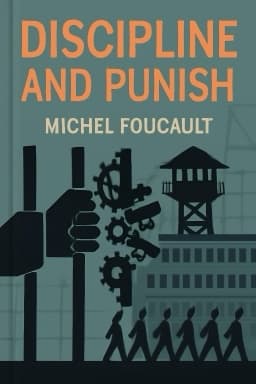
Michel Foucault
Foucault’s groundbreaking analysis of how modern society disciplines and controls through institutions, surveillance, and the body.
Foucault’s vivid description of the execution of Damiens at the book’s start is based on historical documents from 1757.
Section 1
6 Sections
Let us begin on a cold morning centuries ago, in a crowded town square, where the drama of justice unfolds before all eyes. The condemned stands trembling, the executioner poised, and the crowd holds its breath. This was not merely justice; it was theater, a ritual in which power and fear danced together. The sovereign’s authority was not abstract—it was written in flesh, in the cries and silences of the punished body.
Yet, as the centuries turned, something profound shifted. The drama faded, the crowds dispersed, and the instruments of pain retreated behind closed doors. No longer would the body be the canvas for society’s vengeance. Instead, punishment slipped into the shadows, becoming a matter of silence, secrecy, and institutional order. The last public guillotining in France, in 1939, was not just the end of a practice but the closing of an era. The spectacle had become an embarrassment, a relic of a less civilized time.
But why this change? Was it simply a matter of growing humanity, of moral progress? Or was there something deeper at play? As we peel back the layers, we see that the shift was not just from cruelty to kindness, but from visible power to invisible control.
Consider, for a moment, the paradox of the crowd. Once, they were participants in justice—cheering, jeering, sometimes even saving the condemned. But as punishment retreated from view, so too did the people’s role. Justice became a private affair, carried out by experts, witnessed only by a select few. The sovereign’s power was no longer performed; it was administered, measured, and justified in the name of order and reform.
This is the story of a transformation—not just of punishment, but of society itself. The move from scaffold to cell, from spectacle to silence, marks the birth of modern discipline. It is a story of loss and gain, of fears tamed and freedoms constrained. And as we leave the square and step into the shadows of the prison, we must ask: what have we traded for our newfound civility? What powers now shape us, unseen and unchallenged?
Let us follow this thread, from the fading echoes of the scaffold to the quiet corridors of discipline, and see how the logic of punishment has seeped into every corner of our lives. In the next section, we will discover how discipline, once the concern of the few, became the foundation of the many.
What was a primary purpose of public executions in early modern Europe?
11 more quizzes available in app
Punishment was once a public event, intended to awe and terrify.
7 more insights available in app
Unlock all 6 sections, 8 insights, full audio, and interactive mind map in the SnapBooks app.