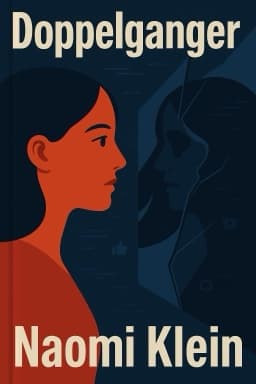
Naomi Klein
A deeply personal and cultural investigation into identity, misinformation, and political division in the digital age.
Naomi Klein wrote 'Doppelganger' partly as a response to being confused with Naomi Wolf, a very different public figure.
1 more facts available in the app
Section 1
7 Sections
Imagine standing in front of a mirror, expecting your own reflection, but instead seeing a stranger who looks exactly like you. This is the chilling essence of the doppelganger experience — a phenomenon that unsettles not only the individual but echoes through culture and society.
Throughout history, the doppelganger has appeared in myths, literature, and psychoanalysis as a symbol of the shadow self — the parts we hide, deny, or fear. It’s the evil twin, the hidden reflection, the warning sign that all is not well.
But the doppelganger is more than personal torment. It reflects societal fractures — the way communities split into polarized camps, each seeing the other as alien or dangerous.
As we embark on this journey through the tangled shadows of self and society, keep in mind that the doppelganger is both a threat and a guide. It forces us to confront what we deny and to question the stories we tell about who we are. This unsettling mirror invites us to step into the next chapter, where the chaos of a global pandemic will amplify these themes in unexpected ways.
What feeling does the doppelganger most commonly evoke according to Freud?
13 more quizzes available in app
Doppelgangers provoke deep psychological unease by confronting us with a distorted reflection of ourselves.
8 more insights available in app
Unlock all 7 sections, 9 insights, full audio, and interactive mind map in the SnapBooks app.
Bryan Stevenson
Joseph Henrich

Katherine Zoepf
Robert Whitaker
How fear and uncertainty during Covid-19 fueled a misinformation epidemic with real-world consequences
