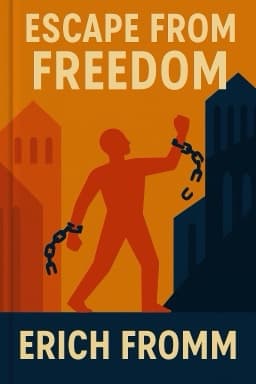
Erich Fromm
A seminal analysis of modern freedom's paradox: liberation breeds isolation, driving individuals toward authoritarianism, conformity, or genuine self-realization.
Erich Fromm wrote Escape from Freedom during World War II, capturing the psychological turmoil of the era.
Section 1
7 Sections
Imagine a world where chains are broken, where the individual is suddenly free from the shackles of external authority. This freedom, so long desired and fought for, seems like a triumphant dawn. Yet,
Throughout history, oppressed peoples have battled valiantly for freedom, embracing the hope of self-governance and personal autonomy. Yet, curiously, many who achieved this freedom later sought new forms of submission. This seeming contradiction unveils the psychological complexity beneath the political struggle. Freedom, while promising autonomy, also confronts the individual with the daunting task of self-definition and responsibility.
Consider the individual emerging from the protective cocoon of childhood, suddenly aware of their separateness and the vastness of the world outside. This awakening mirrors the historical emergence of the individual from the medieval social order—once secure, now adrift. The primary ties that once gave a sense of belonging and purpose are severed, replaced by the challenge of forging new connections without losing oneself. It is a journey marked by both growth and pain, strength and vulnerability.
In this light, freedom is not a simple state but a dynamic process, fraught with tension between the desire for autonomy and the need for security. The individual may respond by embracing freedom, seeking positive self-expression, or by fleeing into new dependencies—authoritarian submission, conformity, or destructiveness. These mechanisms serve as psychological escapes from the unbearable weight of isolation.
As we embark on this exploration, let us keep in mind that freedom's true challenge is not merely external but deeply internal. Understanding this paradox is the key to unraveling the complex relationship between society, psychology, and the human spirit.
With this foundation, we now turn to the historical roots of this paradox, tracing the emergence of the individual and the ambiguity of freedom in the crucible of social and economic change.
What paradox does freedom present according to the discussion?
13 more quizzes available in app
Freedom liberates but also isolates, creating psychological tension.
8 more insights available in app
Unlock all 7 sections, 9 insights, full audio, and interactive mind map in the SnapBooks app.
Unveiling the paradox of freedom and why it sometimes terrifies us more than it liberates.
Read articleDiscover the surprising ways freedom can bind us and why many choose chains over liberty.
Read article