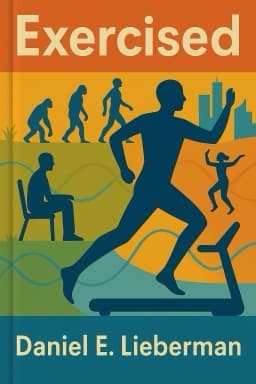
Daniel E. Lieberman
A revelatory look at why humans struggle with exercise, grounded in evolutionary biology and anthropology.
The first treadmills were invented as punishment devices for prisoners in Victorian England.
Section 1
7 Sections
Let’s begin our journey with a gentle realization: the world we inhabit today is vastly different from that of our ancestors, not just in its technology or comforts, but in how we think about movement itself.
Imagine a community in rural Africa, where women carry water on their heads for miles, or a child in the Andes who runs up steep hills as part of daily chores. These are not workouts—they are life itself. Our ancestors did not run for fun or walk for heart health. Instead, every step, every lift, every climb was purposeful. The treadmill, now a symbol of modern fitness, was once a grim tool of punishment in Victorian prisons, forcing inmates to trudge endlessly as a form of discipline.
Words themselves reveal this shift. The term 'exercise' entered English in the Middle Ages, describing hard labor like plowing or training for war. Only in recent centuries did it come to mean planned, voluntary activity for health. Today, we see gyms on every corner, wearable devices tracking our every move, and a booming industry built on the idea that we must compensate for our sedentary lives by exercising. Yet, our bodies and instincts are shaped by a world where movement was not optional, but essential.
Why does this matter? Because it helps us understand why so many struggle with exercise, why guilt and confusion surround it, and why modern solutions often feel unnatural.
What was the original purpose of treadmills?
13 more quizzes available in app
Exercise for health is a recent cultural development, not an ancient instinct.
7 more insights available in app
Unlock all 7 sections, 8 insights, full audio, and interactive mind map in the SnapBooks app.
Discover why your brain resists the gym and how evolution explains our modern struggle with movement.
Read articleDebunking the biggest myths about sitting, rest, and sedentary living—what the science and anthropology really say.
Read article
Adam Sinicki

Genevieve Howland
Lauren Roxburgh
Katy Bowman
