Harvard Business Review Press
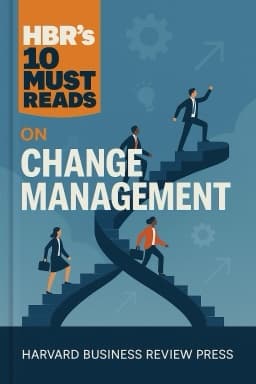
A definitive guide compiling expert insights on successfully leading and managing organizational change.
The book is a curated collection of articles originally published in Harvard Business Review, bringing together decades of research and practice on change management.
Section 1
8 Sections
Every journey begins with a first step, and in the realm of organizational change, that step is the realization that the status quo is no longer tenable.
At the heart of successful change lies the creation of a powerful sense of urgency. This urgency is more than just a fleeting feeling; it is a shared conviction among roughly three-quarters of an organization's management that business as usual is unacceptable. Without this widespread urgency, efforts to transform falter before they even begin.
Consider the story of a company whose management underestimated the difficulty of pushing people out of their comfort zones. Despite early warnings about declining margins and emerging competition, complacency held sway. The result? A slow-motion slide into irrelevance. In contrast, another organization deliberately engineered a crisis to shake its people awake. One CEO orchestrated the largest accounting loss in the company's history, creating enormous pressure from Wall Street. Though risky, this bold move made the status quo seem more dangerous than the uncertain future, galvanizing the workforce into action.
Establishing urgency is not a simple task. Leaders often hesitate, fearing that stirring the pot will damage morale, provoke defensiveness, or jeopardize short-term results. Yet, without this critical spark, change efforts lack the fuel to ignite.
Once urgency is established, the next phases unfold: forming a guiding coalition, crafting a clear and compelling vision, communicating that vision relentlessly, removing obstacles, and celebrating short-term wins to build credibility. Each phase is indispensable. One company’s failure to remove a single obstructive division leader stalled its entire change effort, breeding cynicism and collapse. Conversely, another organization’s strategic short-term wins, such as the rapid launch of a promising new product, bolstered belief and commitment across the company.
As we journey forward, we will explore how leadership styles shape change, how values can serve as a guiding star, and how resistance can be understood and overcome. Each step is a piece of the puzzle, helping us navigate the complex landscape of transformation.
Now, let us turn our attention to the role of leadership and persuasion in making change not only possible but embraced.
What is the primary reason many organizational change efforts fail?
15 more quizzes available in app
Successful transformation requires progressing through defined stages, each building on the last.
8 more insights available in app
Unlock all 8 sections, 9 insights, full audio, and interactive mind map in the SnapBooks app.
Discover the hidden pitfalls in change initiatives and master the proven strategies to make change stick.
Read articleMaster the four-stage persuasion campaign that prepares your organization to embrace change willingly.
Read article
Patricia Pulliam Phillips and Jack J. Phillips

Scott Tannenbaum and Eduardo Salas

J.J. Sutherland

Eric Schmidt, Jonathan Rosenberg, and Alan Eagle
