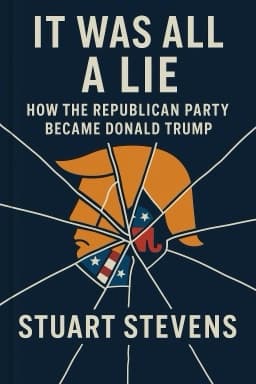
Stuart Stevens
A candid insider's analysis of how the Republican Party's embrace of race, deception, and fear paved the way for Donald Trump's presidency and reshaped American conservatism.
Stuart Stevens was a top strategist for Mitt Romney's presidential campaigns before becoming a vocal critic of Donald Trump.
Section 1
10 Sections
Imagine a political landscape where the currents of race run so deep that they quietly but powerfully shape every decision, every campaign, every election. This was the reality for the Republican Party starting in the mid-20th century. The party’s trajectory was profoundly altered by race, not as an incidental factor but as the very thread weaving its identity. It began with a strategic pivot in the 1960s, when the party consciously chose to appeal to white voters in the South by tapping into their racial anxieties and resentments. This was not a blunt or overt appeal but a carefully coded one, deploying phrases like 'states’ rights' and 'forced busing' to signal opposition to civil rights progress without explicit racial language.
Before this transformation, Republicans had enjoyed substantial support among African American voters, with candidates like Dwight Eisenhower and Richard Nixon winning 30 to 40 percent of the black vote. However, Barry Goldwater’s opposition to the Civil Rights Act in 1964 caused a precipitous fall in black voter support, plunging it to historic lows that have never recovered. This decline was not accidental but a direct consequence of the party’s choice to prioritize white voters who opposed integration and equality.
Campaigns began to exploit racial divisions more explicitly. One striking example involved promoting independent African American candidates in districts with significant black populations to split the vote and enable Republican victories. This tactic demonstrated the cold calculation behind the party's racial politics — race was not merely a social issue but a tool wielded to win elections. The consequences of these choices reverberate today, as the Republican Party remains largely a party of white voters, with minimal support from African Americans and other minorities.
Yet, this is not just history; it is the lens through which we must understand the present. The party’s identity, policies, and rhetoric continue to be shaped by this legacy. The echoes of coded racial appeals persist in modern political discourse, and the demographic shifts across the nation pose existential questions for the party’s future.
As we move forward, we will see how this racial thread intertwines with other powerful forces — cultural values, political deception, and media manipulation — to create a complex tapestry of American politics. The next chapter will take us into the realm of 'family values,' a phrase that has been wielded as a weapon and a shield, revealing yet another layer of this intricate story.
What was the 'Southern Strategy' primarily designed to do?
19 more quizzes available in app
Race has been a foundational and defining element in Republican Party politics for decades.
8 more insights available in app
Unlock all 10 sections, 9 insights, full audio, and interactive mind map in the SnapBooks app.
A Deep Dive into How Race, Fear, and Deception Reshaped America’s GOP
Read articleUnpacking the Racial Foundations and Consequences of GOP Strategy
Read article
Christopher Hitchens
Select Committee to Investigate the January 6th Attack on the United States Capitol
Tim Alberta
Samuel T. Francis
