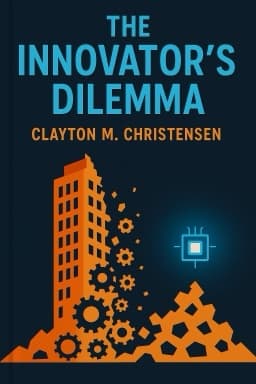
Clayton M. Christensen
A seminal guide explaining why good companies fail with disruptive innovations and how to manage innovation strategically.
The term 'disruptive technology' was popularized by Clayton Christensen in this book.
Section 1
9 Sections
In the world of business, we often celebrate companies that listen closely to their customers and innovate in response to their needs. Yet, there lies a paradox:
Consider the story of a retail giant once hailed as a paragon of management excellence. In the 1960s, this company was praised for its natural, seemingly effortless success. Yet, as discount retailers and home centers emerged, it clung to its traditional customer base and methods. Its failure to recognize the changing landscape led to a precipitous decline, despite its reputation for good management.
This phenomenon is not isolated. In the disk drive industry, rapid technological advances and shifting market demands created opportunities for new entrants to overtake established leaders repeatedly. These incumbents excelled at sustaining innovations—those that improved performance along dimensions valued by their mainstream customers. However, disruptive innovations—simpler, cheaper, and initially lower-performing technologies—found fertile ground in emerging markets that incumbents overlooked.
The paradox deepens:
Thus, the first insight is clear:
What paradox do great companies face according to this section?
17 more quizzes available in app
Good management practices can paradoxically cause failure when disruptive technologies emerge.
8 more insights available in app
Unlock all 9 sections, 9 insights, full audio, and interactive mind map in the SnapBooks app.
Discover the paradox that top companies face and how to avoid the pitfalls that cause even the best to stumble.
Read articleUnlock the secrets to navigating disruptive change and leading your organization to lasting success.
Read article
Patricia Pulliam Phillips and Jack J. Phillips
Scott Tannenbaum and Eduardo Salas
J.J. Sutherland
Eric Schmidt, Jonathan Rosenberg, and Alan Eagle
