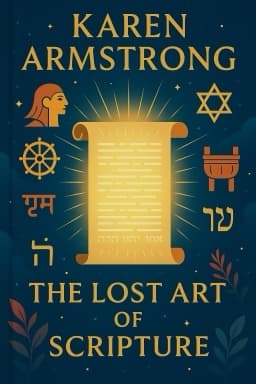
Karen Armstrong
An insightful exploration of the origins, functions, and transformative power of sacred scriptures across cultures and history.
Karen Armstrong was once a Roman Catholic nun before becoming a renowned religious scholar.
Section 1
7 Sections
Imagine a time 40,000 years ago, when a small community of Homo sapiens gathered in a deep cave, their flickering firelight casting shadows on the walls adorned with primitive paintings. At the center stood a remarkable figurine, carved from mammoth ivory — a creature with the body of a man and the head of a roaring lion. This is the Lion Man, one of the earliest known religious artifacts, revealing a profound truth about our ancestors: they were not merely hunters and gatherers but imaginative beings capable of envisioning realities beyond the immediate and tangible.
This figurine was no mere decoration; it was a sacred object, caressed repeatedly, its presence a focal point for communal ritual and storytelling. It embodied the instinctive human yearning to connect with a reality that transcended the physical world — a reality infused with meaning, mystery, and unity. The Lion Man stands as a testament to the birth of religion and the sacred as an art form — a fusion of myth, ritual, and imagination that continues to shape human culture.
Modern neuroscience has uncovered that this capacity for sacred vision is deeply rooted in the human brain, particularly in the right hemisphere. Unlike the left hemisphere, which specializes in language, analysis, and pragmatic thought, the right hemisphere sees the world holistically. It perceives connections and relationships, embraces metaphor, and fosters empathy and justice.
Throughout history, societies have cultivated this right-brain awareness through ritual, myth, and sacred texts. These cultural practices help individuals transcend their egos, connect with the Other, and glimpse the infinite within the finite. The Lion Man figurine reminds us that from the very beginning, humans have sought to embody the sacred, to become more than themselves by aligning with a transcendent unity that pervades all things.
This early fusion of imagination, ritual, and community laid the groundwork for the emergence of scripture — texts that are not merely historical records or factual accounts but living works of art that must be experienced and embodied. As we journey forward, we will explore how these sacred texts evolved in different cultures, each uniquely expressing humanity's quest for meaning and transformation.
Let us now turn to the rich oral traditions of ancient India, where sound and silence became the sacred vessels for transmitting divine knowledge.
What does the Lion Man figurine symbolize in early human culture?
13 more quizzes available in app
Early humans transcended the empirical world by creating symbolic figures and rituals that connected them to a sacred reality.
8 more insights available in app
Unlock all 7 sections, 9 insights, full audio, and interactive mind map in the SnapBooks app.
Discover the profound wisdom hidden in ancient sacred texts and why modern readers need to reclaim the living art of scripture.
Read articleModern society often reduces scripture to dogma or history, but this book reveals how to revive its transformative essence.
Read article