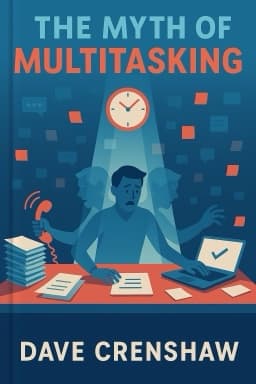
Dave Crenshaw
A practical guide that reveals why multitasking is a myth and provides actionable steps to boost productivity through focused work.
The book popularized the term 'switchtasking' to distinguish it from true multitasking.
Section 1
6 Sections
Let me take you on a gentle journey, my friend, into the world of productivity—a space often cluttered with to-do lists, buzzing devices, and the relentless urge to do it all.
Imagine, for a moment, a busy office. Papers pile up, emails ping, phones ring, and someone—maybe you—tries to handle it all at once. The myth of multitasking is seductive. It promises more done in less time, a badge of honor for the busy. Yet, this myth began not with humans, but with machines. The word 'multitasking' was coined to describe computers, whose processors switch so quickly between tasks that they seem to do them all at once. But unlike computers, our brains are not built to run multiple demanding programs at the same time.
Studies have shown that the average person loses 28% of their workday to interruptions and the time it takes to recover from them. That’s over two hours a day, or more than ten weeks a year, simply lost in the shuffle.
So why do we cling to this myth? Perhaps it’s the rush of feeling busy, the fleeting satisfaction of crossing off two things at once. But if you look closely, you’ll see that the price is steep: more mistakes, more stress, and less true accomplishment. The illusion of multitasking is just that—an illusion.
As we step forward, let’s gently set aside the myth and open ourselves to a new way of working and living. In the next section, we’ll explore the hidden costs of multitasking—and why the price is higher than you might ever imagine.
What is the true origin of the term 'multitasking'?
11 more quizzes available in app
Multitasking is widely believed to boost productivity, but in reality, it is an illusion that leads to inefficiency.
6 more insights available in app
Unlock all 6 sections, 7 insights, full audio, and interactive mind map in the SnapBooks app.