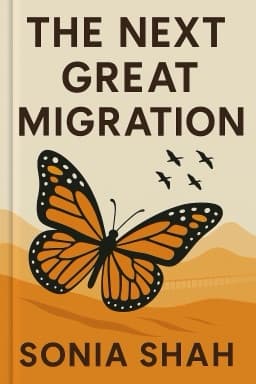
Sonia Shah
A transformative exploration of migration as a natural, essential process, challenging myths and advocating for humane policies amid global change.
Edith’s checkerspot butterfly was one of the first species documented to shift its range due to climate change.
2 more facts available in the app
Section 1
8 Sections
Imagine a quiet morning in the dry scrublands of southern California, where the earth is sunbaked and the hills roll gently into the horizon. Here, amidst the subtle russet grasses and tiny white flowers, a delicate drama unfolds: a small butterfly flutters low to the ground, its spotted wings barely noticeable to the casual observer. This butterfly, known as Edith’s checkerspot, is no ordinary insect. It is a messenger, carrying a vital story about life on the move in a warming world.
For decades, scientists believed many species were too sedentary to adapt by moving to new habitats. The checkerspot’s slow, low flights seemed to confirm this. Yet, through careful observation and data analysis, it became clear that this butterfly was defying expectations, migrating to cooler climes as southern habitats dried and heated beyond its tolerance.
From the coral reefs of Japan, where coral polyps have been observed moving northward at an astonishing pace, to the Atlantic cod swimming into cooler waters, nature’s creatures are on the move. Even the seemingly immobile coral reefs, the stone walls of the ocean, are migrating, slowly but surely, adapting to new conditions.
Humans, too, are part of this grand migratory story. Our ancestors journeyed across continents and oceans, adapting biologically and culturally to new environments. Today, millions move across borders and cities, driven by a complex web of environmental, social, and economic factors.
Yet, despite this natural imperative, migration is often misunderstood, feared, and resisted. The story of the little checkerspot butterfly reminds us that movement is essential, not optional. It is a process that sustains biodiversity and human societies alike, offering hope in the face of unprecedented environmental change.
As we reflect on these truths, we begin to see migration not as a crisis but as a natural response to a shifting world, an invitation to adapt and endure. Let us now delve deeper into the historical ideas that have shaped our understanding of migration and the myths that have clouded this essential phenomenon.
What biological phenomenon did the Edith’s checkerspot butterfly help reveal?
15 more quizzes available in app
Migration is a natural, ongoing process essential for survival across species.
8 more insights available in app
Unlock all 8 sections, 9 insights, full audio, and interactive mind map in the SnapBooks app.
Discover the surprising story behind a fragile butterfly that changed how we see migration in a warming world.
Read articleFrom crime waves to disease fears—why the real story about migration is one of hope and resilience.
Read article
Bryan Stevenson

Joseph Henrich

Katherine Zoepf

Robert Whitaker
