Steven G. Rogelberg
A science-driven blueprint for transforming meetings into productive, engaging, and essential organizational tools.
The book estimates that the annual cost of meetings in the U.S. is $1.4 trillion—about 8% of the 2014 GDP.
Section 1
7 Sections
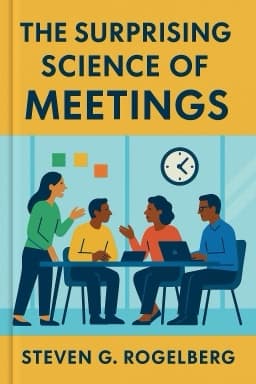
Let me take you on a gentle journey into the heart of modern work—the meeting. Imagine, for a moment, an ocean of glass-walled rooms and flickering screens, where people gather in clusters, their faces illuminated by laptops, their voices weaving a tapestry of ideas and interruptions. This is the world of meetings, a world that has quietly expanded until it touches nearly every working hour of our lives.
Meetings are not merely a fixture of office life; they are its backbone and, sometimes, its burden. We attend them to share, to align, to decide, and to belong. But beneath the surface, there’s a hidden current—the true cost of meetings. It’s not just the visible outlay of salaries and rented rooms. It’s the energy sapped from a team when a meeting meanders without purpose, the creativity lost when voices go unheard, the morale drained by another hour spent in a room where nothing changes. This is the shadow side of meetings, and it’s vast: estimates put the annual cost of meetings in the US at a staggering $1.4 trillion, a figure that dwarfs many industries and rivals the budgets of entire nations.
But the cost isn’t just financial. There’s a phenomenon called meeting recovery syndrome—a phrase that captures the fatigue and frustration that lingers after a bad meeting, like a fog that settles over the rest of the day. This syndrome doesn’t just affect the person in the meeting; it ripples outward, touching colleagues, teams, and even families.
And yet, meetings persist. Why? Because in our quest for inclusion, for transparency, for organizational democracy, we’ve built a culture where meetings are the primary tool for communication and decision-making. Organizations have become flatter, more collaborative, and less hierarchical, and with that has come a surge in meetings. It’s a paradox: the very thing designed to bring us together can sometimes push us apart from our best selves.
But there is hope. The story of meetings is not one of inevitable decline, but of opportunity—if we can learn to see the patterns, measure the costs, and ask ourselves what truly matters. As we move forward, let’s explore not just why meetings go wrong, but how we can reclaim them as a force for good. Next, we’ll discover that the answer isn’t to abolish meetings, but to transform them through science and intention.
What is the estimated annual cost of meetings in the US?
13 more quizzes available in app
Meetings have become a central part of modern work life.
7 more insights available in app
Unlock all 7 sections, 8 insights, full audio, and interactive mind map in the SnapBooks app.