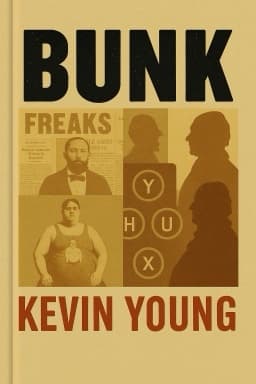
Kevin Young
A comprehensive cultural history exploring the evolution and impact of hoaxes, deception, and fake news in America.
P.T. Barnum once exhibited Joice Heth, a black woman he claimed was George Washington’s nursemaid, who was likely a slave and not nearly as old as advertised.
2 more facts available in the app
Section 1
9 Sections
In the swirling mists of 19th-century America, a new kind of spectacle was born — one where truth and falsehood danced so closely they became indistinguishable. This was the age of humbug, a uniquely American phenomenon where deception was not merely a crime but a form of art, a performance that invited audiences to willingly suspend disbelief. Imagine crowds gathering eagerly around the American Museum, the air thick with anticipation and curiosity, ready to be both fooled and entertained. The Feejee Mermaid, a grotesque chimera sewn together from a monkey's torso and a fish's tail, was the star attraction. Visitors felt the thrill of being duped but also the quiet humility of their own eagerness to believe.
The newspapers of the day, especially the penny press, thrived in this atmosphere. The New York Sun’s Moon Hoax of 1835 is a shining example — a series of articles describing fantastic discoveries on the lunar surface, including bat-winged humanoids and unicorn-like creatures. The hoax was crafted with a deft hand, using the language of science to lend credibility to the unbelievable.
Such humbug was distinguished from outright swindling by its intent and reception. A swindler cheats and leaves the audience empty-handed, while a humbug delivers a spectacle worth the price of admission, even if the truth is elusive. This distinction is crucial to understanding the cultural fabric of the time, where shows and stories were as much about the experience as about facts.
As we move forward, we will see how these early spectacles of humbug laid the groundwork for deeper cultural narratives — where race, identity, and belief intertwined in complex ways, and where the hoax became a mirror reflecting society’s deepest anxieties and desires. Let us now step into the world of freak shows and the racialized spectacles that followed, where the human body itself became a stage for deception and meaning.
What distinguished a 'humbug' from a 'swindler' in the 19th century?
17 more quizzes available in app
Humbug was not just fraud but a form of entertainment where audiences willingly participated in the deception.
8 more insights available in app
Unlock all 9 sections, 9 insights, full audio, and interactive mind map in the SnapBooks app.
From P.T. Barnum’s Feejee Mermaid to the Moon Hoax—explore the origins of America’s fascination with humbug and hoaxes.
Read articleHow racialized freak shows exposed America’s hypocrisies and shaped cultural identities in the 19th century.
Read article
Bryan Stevenson
Joseph Henrich

Katherine Zoepf

Robert Whitaker
