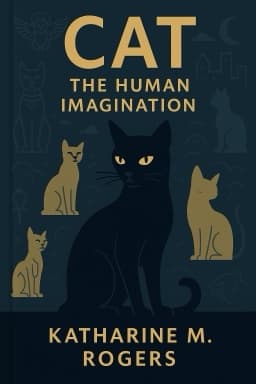
Katharine M. Rogers
An in-depth cultural, historical, and symbolic study of cats and their complex relationship with humans.
Cats have been domesticated for over 4,000 years, primarily for pest control.
4 more facts available in the app
Section 1
8 Sections
Imagine a world tens of millions of years ago, where the ancestors of modern mammals began to diversify after the dinosaurs had vanished. Among these early creatures were the miacids, small tree-dwelling carnivores about the size of a pine marten.
Fast forward to the African wildcat, Felis sylvestris libyca, whose gentle disposition made it the perfect candidate for domestication. Around 2000 BC, ancient Egyptians welcomed these cats into their granaries to keep the dreaded rodents at bay.
Unlike dogs, which humans selectively bred for various tasks, cats remained largely unchanged. Their natural hunting skills were already perfect, and their independent nature preserved their aloofness and grace. Their retractable claws, sensitive whiskers, and extraordinary night vision allow them to be silent, precise predators.
In fact, cats have nerve endings around their canines that help them place their killing bite with pinpoint accuracy. This biological marvel enables a swift, fatal bite between the vertebrae of their prey’s neck, instantly disabling it. Such precision contrasts sharply with the less exact bite of dogs, who rely more on crushing bones than slicing flesh.
Through this evolutionary lens, we begin to appreciate the cat’s perfect adaptation to its ecological niche. Their flexible spines allow them to twist and turn mid-leap, reaching bursts of speed that surprise even the most agile prey. Their soft padded paws, which retract claws when not in use, enable them to move stealthily, making them masters of the stalk-and-pounce technique.
This section of our journey reveals the biological and historical foundations of our relationship with cats. From wild ancestors to domestic partners, cats have retained their wild essence while becoming integral to human society.
As we move forward, we will delve into how these natural traits of cats fed into their magical and symbolic roles in human imagination, from divine protectors to feared familiars of witches.
What is the primary ancestor of the modern domestic cat?
15 more quizzes available in app
Cats evolved highly specialized physical traits that make them expert hunters.
8 more insights available in app
Unlock all 8 sections, 9 insights, full audio, and interactive mind map in the SnapBooks app.
Discover how cats transformed from wild predators to revered creatures in human culture and religion.
Read articleUnveil the magical myths and superstitions that have surrounded cats throughout history and across cultures.
Read article
Neil Postman
Nick Bostrom
Temple Grandin

Steven Pinker
