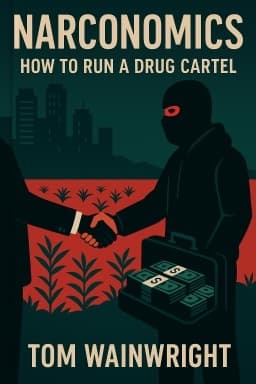
Tom Wainwright
An economic analysis revealing how drug cartels operate like multinational corporations and how this insight can reshape drug policy.
The drug trade's global revenue rivals the GDP of a medium-sized country, estimated at around $300 billion annually.
2 more facts available in the app
Section 1
9 Sections
Imagine a vast green ladder carved into the steep mountainsides of the Andes, where delicate coca leaves grow in terraces tended by humble farmers. This leaf, innocuous to many, is the seed of a global industry worth hundreds of billions of dollars.
Farmers, who often earn less than two dollars a day, have little bargaining power. The cartels act as the sole buyers of coca leaf, setting prices that keep farmers trapped in poverty. When governments destroy crops, these costs are absorbed by the farmers, not the cartels.
The so-called 'balloon effect' further complicates eradication. When one region is squeezed, coca cultivation simply bulges somewhere else. Like cockroaches scattering when the lights come on, the trade adapts swiftly. Moreover, innovations in processing—such as using gasoline-powered hedge trimmers or washing machines as centrifuges—have increased yields, offsetting losses from eradication.
Consider the analogy of beef: no one would price a live steer by the cost of a steak in New York City. Yet, drug officials often value seized drugs by retail street prices, inflating the perceived blow to cartels. In reality, the value at the source is a fraction of the retail price, emphasizing the futility of targeting the earliest stage of the supply chain.
This insight challenges conventional wisdom. Instead of focusing on the fragile coca fields, attention might be better placed downstream, where the product’s value skyrockets and cartels face higher risks and costs. This understanding opens the door to smarter policies that consider the entire supply chain's economics rather than just the roots.
As we move forward, we will see how these economic realities shape competition among cartels, sometimes leading to brutal violence and other times to uneasy truces, depending on market conditions and regulatory environments.
What is the primary reason supply-side eradication efforts fail to significantly increase cocaine prices?
17 more quizzes available in app
Cartels control the market by being the sole buyers of coca leaf, dictating prices to impoverished farmers.
8 more insights available in app
Unlock all 9 sections, 9 insights, full audio, and interactive mind map in the SnapBooks app.

Neil Postman

Nick Bostrom

Temple Grandin

Steven Pinker
