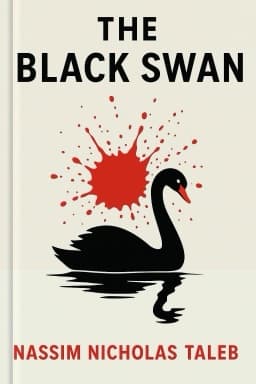
Nassim Nicholas Taleb
A profound examination of rare, high-impact events and our inability to predict or understand them, urging a new approach to uncertainty and risk.
The term 'Black Swan' was inspired by the historical belief that all swans were white until black swans were discovered in Australia.
Section 1
8 Sections
Imagine a world where everything you believe about the future is shaped by what you have seen in the past. We live under the comforting illusion that history moves in a predictable, crawling fashion, but the truth is far more startling.
Take the metaphor of the black swan itself. For centuries, Europeans believed all swans were white, an assumption based on repeated observations. Then, the discovery of black swans in Australia shattered this belief, illustrating how a single observation can overturn millennia of assumed knowledge. This story is not just about birds; it is about our fundamental misunderstanding of reality.
Our cognitive biases lead us to concoct stories after the fact, making Black Swans seem predictable once they happen. We comfort ourselves with explanations that fit neatly into our worldview, yet this retrospective clarity is an illusion.
Consider history’s great surprises: the unexpected rise of Christianity, the swift spread of Islam, the fall of the Soviet Union, or the sudden internet revolution. None were anticipated by the experts of their time, yet all reshaped the world profoundly. On a personal scale, think about the chance encounters, sudden fortunes, or devastating losses that define your life. These moments are Black Swans in action.
But here lies the paradox: we act as if these events do not exist. We build models and make forecasts that exclude the possibility of the unexpected, leaving us vulnerable. The financial markets are a prime example, where risk models often ignore the rare but devastating shocks.
Understanding Black Swans requires humility and a new mindset. It means accepting that most of what matters lies beyond our current knowledge and that the future will remain inherently unpredictable. This awareness is not a cause for despair but a call to prepare wisely and adapt.
As we journey further, we will explore how our minds deceive us, the types of randomness that govern our world, why prediction often fails, and how we can live robustly in the face of uncertainty.
Let us now delve into the fascinating ways our cognition shapes—and distorts—our understanding of these rare events.
What are the three defining attributes of a Black Swan event?
15 more quizzes available in app
Understanding the triplet of rarity, impact, and retrospective predictability.
8 more insights available in app
Unlock all 8 sections, 9 insights, full audio, and interactive mind map in the SnapBooks app.
Discover the hidden forces shaping our reality and how embracing uncertainty can transform your life.
Read articleUnmasking the cognitive illusions that blind us to real risks and how to protect yourself.
Read article
Neil Postman
Nick Bostrom
Temple Grandin
Steven Pinker
