Simon Sinek
A transformative guide on adopting an infinite mindset in leadership to build enduring, ethical, and resilient organizations.
Simon Sinek popularized the concept of 'Start with Why,' which underpins much of his thinking in The Infinite Game.
1 more facts available in the app
Section 1
8 Sections
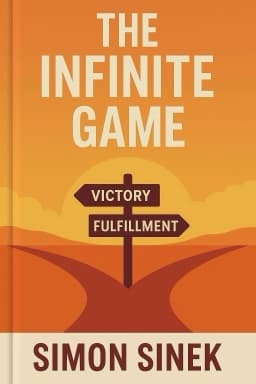
Imagine standing at a crossroads, the early light of dawn casting gentle hues across the landscape. One path promises victory — a finish line with cheering crowds, the thrill of competition, and the finality of winning. The other path offers fulfillment — a journey without end, where the goal is not to finish but to continue, to grow, and to inspire others to join along the way.
In life and business, we often find ourselves caught between these two mindsets. Finite games are familiar: football matches, chess games, and races, all with clear rules, defined players, and a winner declared at the end. But many of the most important pursuits in life — marriage, education, careers, and business — are infinite games. They have no finish line, no final victory, only continuous play.
Consider the Vietnam War as a stark example. Despite winning most battles and inflicting heavier losses on their opponent, the United States did not win the war. Why? Because the opposing side was playing an infinite game, fighting for survival and independence with unyielding will. The US was playing a finite game, seeking a clear victory. When the will to continue faded, the game ended, but not with a clear winner.
In business, too, leaders often mistake the game they are in. They obsess over quarterly earnings, market share, and being 'number one,' treating the company like a finite game. Yet, companies are infinite players — new competitors emerge, markets shift, technologies evolve, and the game continues. The goal is not to win once but to stay in the game indefinitely.
Take the story of Microsoft’s Zune. Despite its quality and design, it failed to unseat Apple’s iPod. The company was playing a finite game — trying to beat a competitor in a market share race. Apple, meanwhile, embraced an infinite mindset, focusing on innovation beyond the iPod, leading to the revolutionary iPhone.
Adopting an infinite mindset transforms leadership. It shifts focus from short-term wins to long-term resilience, from competition to collaboration, and from ego to purpose. It invites us to ask, not 'How do I win?' but 'How do I keep playing and advancing a cause greater than myself?'
As we embark on this journey together, let us explore how embracing the infinite game can reshape our organizations, our leadership, and ultimately, our lives. In the next section, we will delve into the power of a Just Cause — the vision that keeps us inspired to play forever.
What distinguishes an infinite game from a finite game?
15 more quizzes available in app
Understanding the fundamental differences between finite and infinite games and their implications for leadership.
8 more insights available in app
Unlock all 8 sections, 9 insights, full audio, and interactive mind map in the SnapBooks app.
Discover how embracing an infinite mindset can transform your leadership and ensure your organization’s survival and growth in a rapidly changing world.
Read articleExplore the transformative leadership lessons from The Infinite Game that empower you to lead with vision, trust, and resilience.
Read article
Adam Kahane
Neel Doshi and Lindsay McGregor

Tim Sanders
Adrian Gostick & Chester Elton
