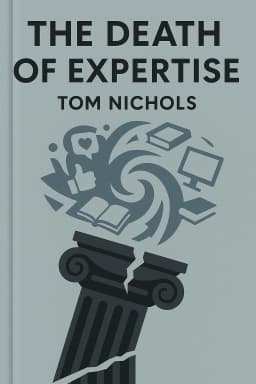
The Death of Expertise: The Campaign against Established Knowledge and Why It Matters - Summary | SnapBooks
Nonfiction
The Death of Expertise: The Campaign against Established Knowledge and Why It Matters
Tom Nichols
21 minAudio8 insights
What you'll learn
•Why expertise matters and how it is being undermined in modern society
•How cognitive biases affect our ability to recognize and accept expert knowledge
•The impact of higher education's commodification on critical thinking
•Ways the Internet amplifies misinformation and erodes trust in experts
•How the media and low-information voters shape public policy debates
•The dangers of conflating opinion with fact in democratic societies
Who should read this
✓Civic leaders and policymakers
✓Educators and university administrators
✓Journalists and media professionals
✓Concerned citizens interested in democracy and public debate
About this book
A sharp critique of society's growing rejection of expert knowledge and its consequences for democracy.
Did You Know?
“
Tom Nichols originally wrote 'The Death of Expertise' as a blog post before expanding it into a book.
Audio Summary
Section 1
The Gentle Rise and Tumultuous Fall of Trust in Expertise
0:00 / 2:59
7 Sections
Preview: The Gentle Rise and Tumultuous Fall of Trust in Expertise
Let me take you back to a time when the word of a doctor, scientist, or engineer was as good as gold. Imagine a world where the people who put a man on the moon were trusted to guide us in every realm of public life, from medicine to foreign policy. This was not so long ago—just a few generations past. In those days, society’s faith in expertise was nearly unshakeable, built on the foundation of visible progress and shared confidence in the promise of modernity. The division of labor was clear: experts solved the hard problems, and the rest of us benefited from their wisdom.
But as time passed, the seeds of doubt began to take root. The world watched as experts made mistakes—sometimes catastrophic ones. The tragedy of thalidomide, the quagmire of Vietnam, and economic crises all served as reminders that even the most credentialed among us could be fallible. These failures were not just blips on the radar; they became cautionary tales that slowly eroded the once-solid foundation of trust.
Yet, the shift was not merely about mistakes. It was also about a changing culture. As society grew more individualistic, a new narrative emerged: the idea that each person’s opinion was as valid as any expert’s view. Populist sentiment, fueled by a desire for autonomy and self-assertion, began to challenge the authority of those who had long been seen as the stewards of knowledge.
In this environment, skepticism flourished. It became fashionable to question, to doubt, even to reject outright the advice of experts. What began as healthy inquiry soon morphed into a prideful ignorance—a badge of honor for those who refused to be ‘talked down to’ by so-called elites.
And so, the gentle rise of expertise gave way to a tumultuous fall. The consequences of this shift are profound, touching every aspect of our lives. As we move forward, we must ask: what happens to a society that no longer trusts those who know more? How does this new landscape shape our conversations and decisions?
Let’s journey now into the world of communication, where the breakdown between experts and the public becomes even more pronounced, and discover how our minds sometimes trip us up on the path to understanding.
Test Your Knowledge
Test Your Knowledge
Q1 of 14
What was a key reason for the initial widespread trust in experts?
13 more quizzes available in app
Visual Mind Map
The Death of Expertise: T...
The Gentle Rise and Tumultuous Fall of Trust in Expertise
The Invisible Barriers: How Our Minds Resist Expert Advice
The Paradox of Higher Education: When Learning Becomes a Product
The Double-Edged Sword: Information Overload in the Digital Age
The Media Mirror: How Journalism and Public Policy Shape Our Knowledge
Bridging the Divide: Healing the Rift Between Experts and the Public
Interactive in appZoom & panExport as image
Key Insights
Key Insight
1 of 8
Historical Trust in Experts
Society once placed immense faith in professionals, trusting their guidance in all facets of life.
7 more insights available in app
Get the Full Summary
Unlock all 7 sections, 8 insights, full audio, and interactive mind map in the SnapBooks app.