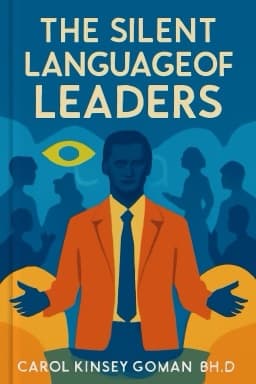
Carol Kinsey Goman, Ph.D.
A comprehensive guide showing how mastering body language enhances leadership effectiveness across negotiation, change, collaboration, and global communication.
People form impressions of leaders within the first seven seconds of meeting.
2 more facts available in the app
Section 1
10 Sections
Imagine walking into a room where your every move is silently scrutinized, your posture, gaze, and gestures speaking volumes before you utter a single word.
Our brain can be thought of as three layers: the reptilian brain, the limbic brain, and the cortical brain. While the cortical brain governs conscious thought and analysis, it is the limbic brain—the emotional center—that first receives and reacts to nonverbal cues. This means that when your body language aligns with your words, you create a powerful, authentic connection. But when they clash, confusion and mistrust arise, as the emotional brain prioritizes what it sees over what it hears.
Consider the example of a polished speaker who, at the end of a presentation, crosses his arms while inviting questions. The audience, unaware of this subtle gesture, suddenly feels a barrier, leading to silence and disengagement. This incongruence between words and body language sends a conflicting message that the emotional brain picks up instantly.
Leaders carry what can be called 'personal curb appeal,' an emotional impression similar to how a passerby judges a house’s exterior. This curb appeal is shaped by warmth—expressed through open postures, genuine smiles, and eye contact—and authority, conveyed by confident stances, controlled gestures, and command of space. The most effective leaders balance these qualities, embodying both approachability and competence.
Research has shown that even brief observations, or 'thin slices' of behavior, can predict long-term perceptions. For example, college students who watched thirty-second clips of teachers could accurately rate their effectiveness at the semester's end, relying mostly on nonverbal cues. This underscores the importance of being mindful of every gesture, expression, and posture.
Understanding these dynamics is the first step toward mastering the silent language of leadership.
Within how many seconds do people form an impression of a leader?
19 more quizzes available in app
Nonverbal signals reach the emotional brain first, influencing perceptions before verbal communication.
8 more insights available in app
Unlock all 10 sections, 9 insights, full audio, and interactive mind map in the SnapBooks app.
Discover the hidden signals that shape your leadership impact and how mastering them can transform your influence.
Read articleMaster the art of silent communication to decode intentions and gain the upper hand in any negotiation.
Read article
Adam Kahane

Neel Doshi and Lindsay McGregor

Tim Sanders

Adrian Gostick & Chester Elton
