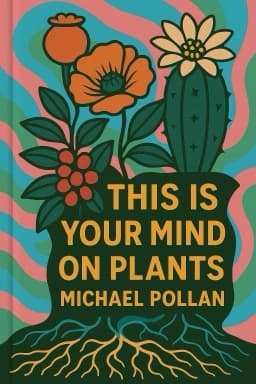
Michael Pollan
A captivating journey through history, science, and culture, exploring how three plant drugs shape human consciousness and society.
Michael Pollan personally abstained from caffeine for several months to research the book, suffering classic withdrawal symptoms.
Section 1
7 Sections
Let’s begin our journey with a simple, beautiful truth: humans have always been drawn to the plants that change our minds. This urge is as old as humanity itself, woven into the fabric of every culture and every era.
Consider the poppy, the coffee bean, the cactus. Each of these plants developed their potent chemicals not for our benefit, but as tools of survival—bitter alkaloids to ward off insects and grazing animals. Yet through a long, sometimes perilous process of trial and error, humans discovered that these same molecules could shift our perception, ease our pain, or spark our imagination.
Across continents and centuries, this discovery has been repeated in countless forms. The Sumerians called the poppy the 'flower of joy.' In the Pacific, kava root became the centerpiece of ceremony and peace-making. In the Americas, peyote and San Pedro cacti opened doors to the sacred. And in the heart of Europe, the rise of coffee transformed both the morning and the mind, fueling the great leap of the Enlightenment.
But why do we do it? Why is ordinary consciousness not enough? Perhaps it’s because the human mind is restless, always seeking novelty, relief, or expansion. Plants offer us a kind of partnership—one where we help them spread and thrive, and they, in turn, offer us new ways to think, feel, and connect. This is not a one-way street, but a dance as old as time, a co-evolution that has shaped not just biology, but the very course of civilization.
Think of the coffeehouse: a place where people gathered not to drink alcohol and dull their senses, but to awaken, to debate, to dream. Or the sacred circle where peyote is consumed in prayer and healing. Or the humble cup of tea that starts so many days and soothes so many hearts. These rituals are more than habits; they are ways of connecting to something larger—nature, community, the mystery of the mind itself.
And so, as we begin this exploration, remember:
Why did plants develop psychoactive chemicals?
13 more quizzes available in app
Humans everywhere seek to change their minds, driven by curiosity, creativity, and the desire for relief from pain or monotony.
7 more insights available in app
Unlock all 7 sections, 8 insights, full audio, and interactive mind map in the SnapBooks app.
From Ancient Rituals to Your Coffee Cup: The Evolutionary Dance Between Plants and People
Read articleHow Three Plants Molded Civilizations, Inspired Revolutions, and Created Modern Life
Read article
Bryan Stevenson

Joseph Henrich

Katherine Zoepf

Robert Whitaker
